Trazodone Alternatives — 7 Options When Trazodone Is Not Working for You
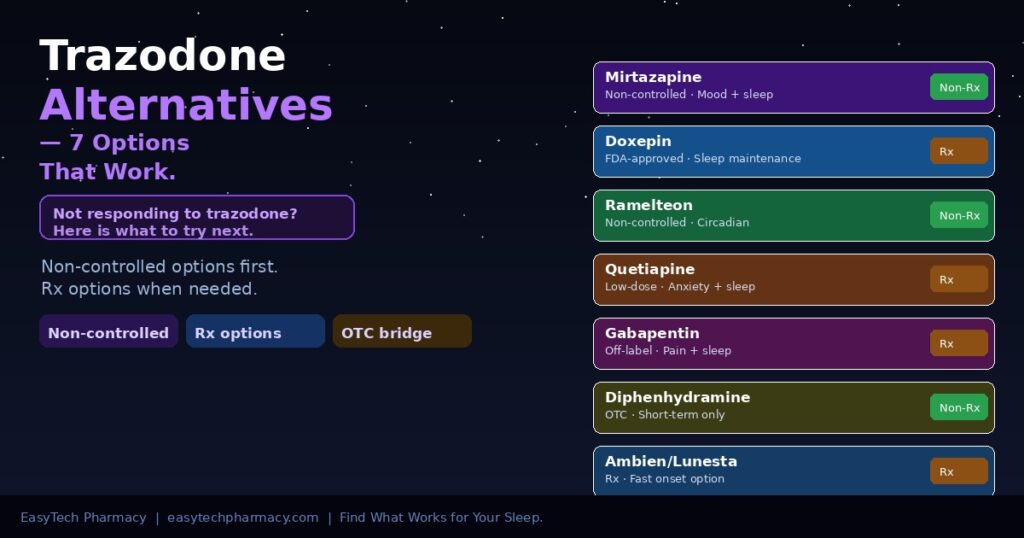
Trazodone works well for a lot of people. It is non-controlled, affordable, and reasonably effective for the kind of chronic insomnia where anxiety and mood are part of the picture. It is one of the most commonly used sleep medications in the US precisely because it hits a useful sweet spot — meaningful sedation without the dependence concerns of Schedule IV medications.
But it does not work for everyone,Some people find the onset too slow,Some experience next-morning grogginess that is too pronounced ,Some find it addresses one part of their sleep problem — falling asleep — but not another — waking at 3am. And some simply do not respond to it the way most patients do.
If you are in one of those situations, this guide covers trazodone alternatives — seven options ranked by mechanism, who each one fits, and what the practical trade-offs actually look like. No guessing. No vague “ask your pharmacist” deflection. Real options clearly explained.
For the full context of how trazodone compares to Ambien — which helps clarify where each fits — our guide on trazodone vs Ambien covers that comparison in depth.
Why Trazodone Does Not Work for Everyone
Before exploring alternatives it helps to understand exactly why trazodone falls short for certain patients — because the reason determines which alternative is most likely to work.
Onset too slow: Trazodone typically takes 45 to 90 minutes to produce drowsiness — longer than zolpidem’s 15 to 30 minutes. For people whose primary problem is lying awake for hours, this slower ramp-up can feel inadequate or produce sedation at the wrong time relative to bed.
Duration too long or too short: At higher doses, trazodone’s sedative effect extends well into the next morning for some people — producing grogginess that affects work performance. At lower doses it may not produce enough coverage to prevent early morning waking.
Insufficient sedative potency: Trazodone’s sedation is relatively mild at the low doses used for sleep. People with significant insomnia — particularly hyperarousal-driven insomnia where the nervous system is strongly activated — may find trazodone simply does not produce enough sedation to overcome the arousal state.
Side effects: Dizziness on standing (orthostatic hypotension), dry mouth, and in rare cases priapism lead some patients to discontinue trazodone despite initial effectiveness.
Not addressing the right problem: Trazodone works best when insomnia has an anxiety or mood component. For primary insomnia without mood involvement — or for circadian rhythm issues — its mechanism may not be the right match.
Alternative 1 — Mirtazapine (Best Non-Controlled Alternative)
Mirtazapine is an antidepressant that works through norepinephrine, serotonin, and histamine pathways — producing significant sedation at low doses (7.5mg to 15mg) primarily through histamine H1 blockade. At these sleep doses the antidepressant effect is minimal; the sedation is the primary effect.
It is not a controlled substance. It does not carry the dependence risk of Z-drugs. For patients who have tried trazodone and found it insufficiently sedating, mirtazapine often produces a noticeably stronger sedative effect at the same non-controlled risk level.
Best for: insomnia with anxiety, depression, appetite loss, or significant weight loss. Mirtazapine frequently increases appetite — which makes it particularly useful for patients with co-occurring low appetite but means weight gain is a concern for patients without this issue.
Key limitation: Weight gain is common with extended use at higher doses. Also requires a short tapering period when discontinuing rather than stopping abruptly.
Availability: Widely available as a generic at very low cost — typically $10 to $20 per month with a GoodRx coupon.
Alternative 2 — Doxepin at Low Dose (Only FDA-Approved for This Exactly)
Doxepin is a tricyclic antidepressant that, at very low doses (3mg to 6mg branded as Silenor), has specific FDA approval for insomnia — particularly sleep maintenance insomnia. This is distinct from the 75mg to 300mg doses used for depression.
At sleep doses, doxepin works primarily through histamine H1 blockade — similar to mirtazapine — but more selectively, with significantly fewer of the anticholinergic side effects that made older tricyclics problematic. It is not a controlled substance. It can be used longer term without the tolerance concerns of Z-drugs.
Best for: people whose primary issue is waking too early or in the middle of the night — sleep maintenance rather than onset. Its FDA insomnia indication is specifically for patients who have difficulty staying asleep.
Key advantage over trazodone: More selective mechanism with a cleaner side effect profile at sleep doses. Less next-morning grogginess than trazodone at equivalent sedation levels for many patients.
Cost: Brand Silenor is expensive. Generic doxepin (compounded at low doses) is the more affordable route — check with your pharmacist about availability at appropriate sleep doses.
Alternative 3 — Ramelteon (Non-Controlled, No Dependence Risk)
Ramelteon (Rozerem) works through a completely different pathway from all other prescription sleep medications — it binds to melatonin receptors MT1 and MT2 rather than GABA or histamine pathways. This means it has essentially no abuse potential, no dependence risk, and no next-morning impairment at standard doses.
According to MedlinePlus, ramelteon is FDA-approved for sleep onset insomnia with no restriction on duration of use — making it uniquely positioned among prescription sleep aids as a long-term option.
Best for: people who cannot or should not use GABA-acting medications (substance use history, history of sleepwalking, certain liver conditions), older adults where fall risk from more sedating medications is a concern, and people whose insomnia has a circadian timing component.
Limitation: Its effect is subtle — more of a melatonin amplification than a sedation. Does not produce the strong sedative effect of trazodone. People with significant insomnia driven by hyperarousal may find it insufficient alone.
Alternative 4 — Low-Dose Quetiapine (Off-Label but Widely Used)
Quetiapine (Seroquel) is an atypical antipsychotic that at low doses (12.5mg to 50mg) produces strong sedation through histamine and serotonin blockade. It is not FDA-approved for insomnia but is widely used off-label for this purpose — particularly for insomnia with anxiety, PTSD, or mood disorder components.
Best for: complex insomnia with co-occurring anxiety, trauma history, bipolar disorder, or situations where other options have failed. Produces stronger sedation than trazodone at sleep doses.
Significant limitations: Metabolic effects — weight gain, blood sugar changes — are a concern even at low doses with extended use. Not a first-line option. Should only be considered after simpler options have been tried.
Not a controlled substance — but its side effect profile at any dose warrants careful monitoring.
Alternative 5 — Gabapentin (Off-Label, Particularly for Pain-Related Insomnia)
Gabapentin works through calcium channel modulation in the nervous system — reducing neural excitability and producing sedation as a prominent side effect. It is not FDA-approved for insomnia but is widely used off-label, particularly for patients whose sleep difficulty is connected to chronic pain, restless legs syndrome, or neuropathy.
Best for: insomnia where pain or restless legs are a significant contributing factor. The sedative and pain-relieving effects work together in a way that no other sleep medication provides.
Key difference from trazodone: Gabapentin addresses the physical dimension of sleep disruption more directly — particularly useful when sleep is broken by pain or limb discomfort rather than primarily by anxiety or mood.
Becoming Schedule V in some states: Due to increasing awareness of misuse, some states have added gabapentin to their controlled substance lists. Check your state’s current classification before making decisions based on its non-controlled status.
Alternative 6 — OTC Antihistamines as a Short-Term Bridge
Diphenhydramine (ZzzQuil, Unisom SleepMelts) or doxylamine (Unisom SleepTabs) can serve as a temporary bridge — a few nights of sleep support while a longer-term alternative is being arranged or trialed.
These are not trazodone alternatives in a long-term sense — tolerance develops within 3 to 5 days and side effects accumulate. However, for someone transitioning off trazodone while waiting for a new medication to begin, they provide temporary sleep support without requiring a new authorization immediately.
For a full breakdown of every OTC sleep option, our guide on Ambien over the counter alternatives covers what works and for how long at each OTC level.
Alternative 7 — Z-Drugs (When Non-Controlled Options Are Insufficient)
When non-controlled alternatives to trazodone do not produce adequate sleep — and the sleep problem is genuinely significant — Z-drugs (zolpidem, zaleplon, eszopiclone) represent the next step up. They produce fast, reliable sedation through direct GABA-A amplification in a way that no non-controlled medication can match.
The trade-offs are well-established — Schedule IV controlled substance, tolerance risk with extended use, next-morning impairment concerns, and the recommendation for short-term use. But for patients who have tried multiple non-controlled alternatives and found them insufficient, Z-drugs address the problem more directly than any other approach.
For people moving from trazodone to considering Ambien specifically, our guide on buy Ambien online covers the full access process. And for the complete side-by-side comparison of what changes when switching from trazodone to a Z-drug, our guide on trazodone vs Ambien covers every dimension.
Decision Guide — Which Alternative Fits Your Situation
| Why Trazodone Did Not Work | Best Alternative | Controlled? |
|---|---|---|
| Not sedating enough | Mirtazapine or low-dose quetiapine | No |
| Too much next-morning grogginess | Ramelteon or low-dose doxepin | No |
| Still waking in the middle of the night | Low-dose doxepin or Ambien CR | No / Yes |
| Pain or restless legs disrupting sleep | Gabapentin | Varies by state |
| Onset too slow | Zolpidem IR or zaleplon | Yes — Schedule IV |
| Anxiety driving insomnia | Mirtazapine or low-dose quetiapine | No |
| Circadian timing issue | Ramelteon | No |
| Weight gain concern | Ramelteon or doxepin (avoid mirtazapine) | No |
| Need short-term bridge while switching | Diphenhydramine OTC (3–5 nights only) | No |
Non-Drug Alternatives Worth Trying Before or Alongside Medication
For patients who want to reduce reliance on any sleep medication — not just trazodone — these behavioral approaches consistently produce durable improvements that medication alone cannot match.
CBT-I (Cognitive Behavioral Therapy for Insomnia) is the clinical gold standard for chronic insomnia. Available through telehealth, licensed therapists, and apps like Sleepio and Somryst. According to the Sleep Foundation, CBT-I produces improvements that persist after treatment ends — unlike medication which stops working when stopped.
For people whose anxiety is a significant driver, our guide on does Ambien help with anxiety explains the anxiety-insomnia cycle and why behavioral approaches often outperform medication for this specific pattern.
And for a complete picture of all non-habit-forming options at every level, our guide on sleeping pills that are not habit forming covers the full range from supplements through prescription non-controlled options.
What to Tell Your Pharmacist When Switching
When transitioning from trazodone to any alternative, these details help your pharmacist identify the most appropriate option quickly:
- What specifically was not working — sedation strength, duration, side effects, or timing
- Whether your insomnia is primarily onset (cannot fall asleep) or maintenance (wake during the night)
- Any co-occurring conditions — anxiety, depression, pain, restless legs
- Your complete medication list including OTC supplements
- Whether dependence risk or next-morning impairment is a particular concern
- Your sleep window — how many hours you have available before needing to wake
These six pieces of information consistently produce better pharmacist recommendations than simply asking “what else can I take for sleep?”
Frequently Asked Questions
What is the best alternative to trazodone for sleep?
It depends on why trazodone is not working for insufficient sedation — mirtazapine for sleep maintenance issues — low-dose doxepin for zero dependence risk and long-term use — ramelteon. For pain-related insomnia — gabapentin. For faster, stronger onset than any non-controlled option provides — zolpidem (Ambien). There is no single best alternative — the match depends on your specific sleep pattern and health history.
Is mirtazapine better than trazodone for sleep?
For patients who find trazodone’s sedation insufficient, mirtazapine typically produces stronger sedation at low doses through its more potent histamine blockade. However, mirtazapine’s weight gain effect is more pronounced than trazodone’s — making it a poor choice for patients already managing weight concerns. Both are non-controlled antidepressants used off-label for insomnia at lower-than-antidepressant doses.
Can I switch from trazodone to Ambien directly?
Yes — trazodone is not physically addictive in the way controlled substances are, so switching does not require a taper in most cases. However, discussing the switch with your pharmacist first is worthwhile — they can confirm the timing, check for interactions with other medications, and help identify the appropriate starting dose for Ambien based on your age, sex, and sleep pattern.
Is there a non-controlled alternative to trazodone that works just as well?
For most patients, mirtazapine at low doses (7.5mg to 15mg) produces similar or stronger sedation to trazodone at the same non-controlled risk level. Low-dose doxepin addresses sleep maintenance specifically with FDA approval and a clean side effect profile. Ramelteon works for circadian issues with essentially no side effect or dependence concern. None is universally superior — the right match depends on your specific situation.
What sleeping pill is stronger than trazodone?
Among non-controlled options: mirtazapine and low-dose quetiapine produce stronger sedation than trazodone for most patients. Among prescription controlled options: zolpidem (Ambien), zaleplon (Sonata), and eszopiclone (Lunesta) all produce faster and more reliable sedation through direct GABA amplification. The question is whether the stronger controlled option is appropriate for your situation — our guide on sleeping pills complete guide covers every level in full.
Bottom Line — Trazodone Is a Starting Point, Not the Only Option
When trazodone is not delivering, the answer is not simply to accept the result. Trazodone alternatives exist at every level — stronger non-controlled options, different mechanism non-controlled options, and prescription Z-drugs for situations where non-controlled approaches are genuinely insufficient.
The key is identifying specifically what is not working before choosing what to try next. Slow onset calls for a different alternative than inadequate maintenance coverage. Pain-related waking calls for a different alternative than anxiety-driven hyperarousal. Matching the alternative to the actual problem produces better outcomes than picking the most commonly recommended option and hoping.
At EasyTech Pharmacy, we carry generic trazodone, generic zolpidem, and a full range of sleep medication options with transparent pricing and pharmacist support. Whether you are moving between non-controlled options or making the step up to a prescription Z-drug, the right next step is easier to identify with the right guidance behind it.
Looking for local pharmacy options? Our Ambien near me guide covers access near you across the US.
Visit EasyTech Pharmacy — find the right sleep medication for your situation today.