Non-Benzo Sleep Aids — Every Option From Mild Supplements to Prescription Strength
The concern about benzodiazepines is well-founded. Medications like Valium, Ativan, Klonopin, and Xanax carry a dependency risk that is higher, faster, and more difficult to manage than most other controlled substances. People who develop physical dependence on benzodiazepines face a withdrawal process that can be genuinely dangerous if not managed carefully. It is not a reputation built on exaggeration.
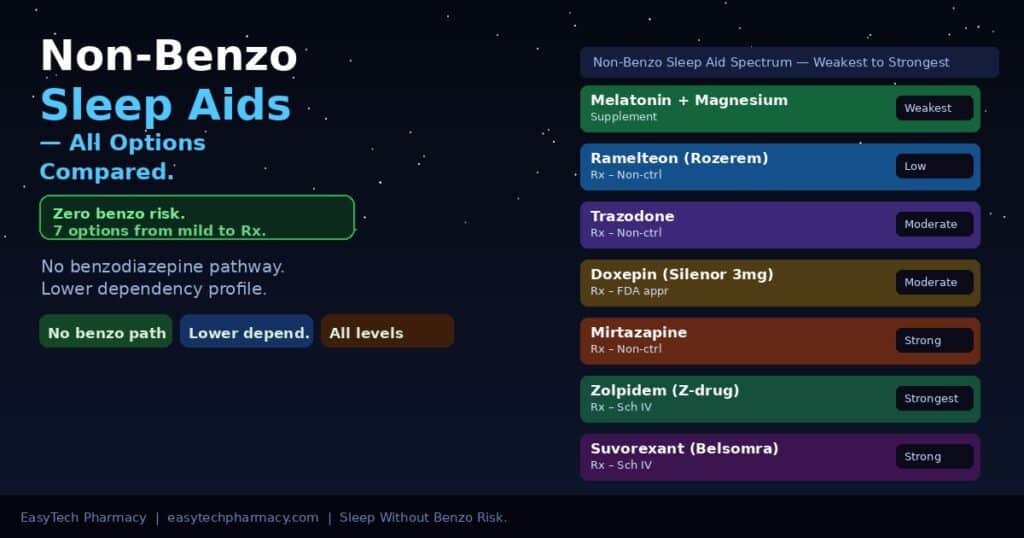
So when someone needs help sleeping — and wants to avoid benzodiazepines entirely — the next question is what actually works without going down that path. The answer covers more ground than most people expect. Non-benzo sleep aids range from over-the-counter supplements to prescription-strength medications that produce reliable sedation through completely different mechanisms — none of which involve the benzodiazepine receptor pathway that carries the highest dependency risk.
This is the complete guide to every meaningful non-benzo sleep option — what each one does, who each one fits, and how to navigate from the gentlest option to the most effective one when gentler approaches are not enough.
For the full spectrum of sleep medications across all categories, our complete sleeping pills guide covers every class including benzodiazepines for comparison context.
Why People Specifically Want Non-Benzo Options
The reasons people specifically seek non-benzo sleep aids fall into a few consistent patterns.
Personal or family history of substance use: People with a history of alcohol or substance use disorder are at significantly higher risk of developing problematic use patterns with benzodiazepines. Many addiction specialists recommend avoiding benzodiazepines in this population entirely — and sleep medication is one of the most common scenarios where the temptation to use them arises.
Previous difficult benzodiazepine experience: Anyone who has experienced benzodiazepine dependence or gone through withdrawal knows the process well enough to actively avoid re-entering it. Even if the medication helps with sleep, the exit cost is not acceptable.
Healthcare provider recommendation: Many pharmacists and healthcare providers now default to non-benzo options as first-line sleep medication — particularly for older adults where the fall risk, cognitive effects, and withdrawal concerns make benzodiazepines disproportionately risky.
Long-term sleep support needed: Benzodiazepines are not appropriate for long-term sleep management in most patients. Someone who needs ongoing sleep support has a strong practical reason to start with options that can be maintained longer.
According to the National Heart, Lung, and Blood Institute, behavioral approaches combined with non-benzo medications represent the current standard of care for chronic insomnia — specifically because the long-term risk profile of benzodiazepines makes them unsuitable as ongoing sleep management tools for most patients.
Level 1 — Supplements (No Prescription, No Controlled Substance)
Melatonin (0.5–3mg)
The most widely used sleep supplement in the US. Works by activating melatonin receptors MT1 and MT2 in the brain’s circadian rhythm center — signaling the body to prepare for sleep. Not sedating in the direct sense but shifts the biological clock toward sleep readiness.
Most effective for: circadian timing issues — jet lag, shift work, delayed sleep phase. Less effective for: primary hyperarousal-driven insomnia. Important dose note — most OTC products contain 5mg to 10mg when 0.5mg to 3mg is the evidence-supported therapeutic range. Lower doses at the right timing outperform high doses taken immediately before bed.
Magnesium Glycinate (200–400mg)
Directly supports GABA activity and reduces cortisol — two physiological mechanisms that block sleep onset. Safe for daily long-term use. No dependency or tolerance risk. Particularly effective for sleep difficulty involving physical tension, anxiety, nighttime muscle cramps, or restless legs. Effects build over 5 to 7 days of consistent use.
L-Theanine (100–200mg)
Promotes alpha brain wave activity — calming cognitive overarousal without sedating. Pairs well with magnesium glycinate for a broader effect covering both physical and mental hyperarousal. No next-morning effects. Safe for regular use.
Our full breakdown of every OTC option is in our guide on Ambien over the counter alternatives.
Level 2 — Non-Controlled Prescription Options
Ramelteon (Rozerem) — The Cleanest Non-Benzo Rx Option
Ramelteon works through melatonin receptor activation — specifically MT1 and MT2 — rather than any GABA pathway. This gives it the cleanest safety profile of any prescription sleep medication No abuse potential,No controlled substance classification,No dependence risk. FDA-approved for sleep onset insomnia with no duration restriction.
Its limitation is potency — it produces subtle melatonin-like effects rather than sedation. Works well for mild insomnia and circadian issues. For significant hyperarousal-driven insomnia, it may not produce adequate effect alone but can be combined with other approaches.
Trazodone (50–150mg at sleep doses)
The most commonly used non-controlled prescription sleep medication in the US. Works through serotonin and histamine pathways to produce moderate sedation with good tolerability. Not FDA-approved specifically for insomnia but widely used off-label. Non-controlled. Can be used longer-term than most sleep medications without escalating dose concerns.
Our detailed comparison of trazodone vs Ambien covers exactly how it compares to Z-drugs in terms of speed, duration, and dependency profile. And for people who have tried trazodone and need the next step, our guide on trazodone alternatives covers every option at the next level.
Low-Dose Doxepin (3–6mg as Silenor)
The only antidepressant with specific FDA approval for insomnia — specifically sleep maintenance insomnia. Works through histamine H1 blockade at low doses without significant anticholinergic effects at standard antidepressant doses. Non-controlled. Particularly effective for people who fall asleep but wake too early. Available as brand Silenor or generic doxepin compounded at low doses.
Mirtazapine (7.5–15mg at sleep doses)
Produces strong sedation through histamine and serotonin receptor activity at low doses. Non-controlled. Useful when trazodone’s sedation is insufficient and the patient wants to avoid controlled substances. Weight gain is a common side effect at higher doses — less pronounced at the 7.5mg sleep dose. Our comparison of trazodone alternatives covers mirtazapine in detail alongside every other non-controlled option.
Gabapentin (Off-Label)
Works through calcium channel modulation — reducing neural excitability and producing sedation, particularly useful when pain or restless legs contribute to insomnia. Non-controlled at federal level though some states have added it to state scheduling. Not a first-line option but useful for specific co-occurring conditions.
Level 3 — Z-Drugs (Schedule IV, Not Benzodiazepines)
This is where the most important clarification in this entire guide lives. Z-drugs — zolpidem (Ambien), zaleplon (Sonata), eszopiclone (Lunesta) — are frequently confused with benzodiazepines. They are not benzodiazepines. They are a distinct drug class.
Why Z-Drugs Are Not Benzodiazepines
Both Z-drugs and benzodiazepines enhance GABA-A receptor activity. However, benzodiazepines bind broadly to all GABA-A receptor subtypes — producing sedation, anxiolysis, muscle relaxation, and anticonvulsant effects simultaneously. This broad binding is why benzodiazepines carry higher dependency risk — more receptor systems are affected and the withdrawal involves more physiological systems.
Z-drugs bind selectively to specific GABA-A receptor subtypes — primarily the ones responsible for sedation — while largely sparing the subtypes responsible for anxiety, muscle relaxation, and anticonvulsant effects. This selectivity is precisely why Z-drugs were developed as alternatives to benzodiazepines for insomnia. They produce the sedation without the full benzodiazepine receptor profile.
This distinction matters practically. Z-drugs carry a lower dependency risk than benzodiazepines — they are Schedule IV rather than Schedule III or IV benzodiazepines (Xanax, Ativan are Schedule IV but with different mechanisms and typically higher clinical dependence rates in practice). They do still carry dependence risk with extended use — which is why they are recommended for short-term use — but it is meaningfully different from benzodiazepine dependence in profile and severity.
Zolpidem (Ambien) — 5mg and 10mg
The most widely prescribed Z-drug in the US. Fast onset (15 to 30 minutes). Immediate-release covers 5 to 6 hours. CR formulation covers 7 to 8 hours. Schedule IV. Available as generic at $8 to $15 per month with GoodRx. For anyone who needs prescription-strength sleep onset support without going through the benzodiazepine pathway, zolpidem is the most accessible and affordable option. Our guide on Ambien and Ambien CR covers both formulations in full detail.
Zaleplon (Sonata) — 5mg, 10mg, 20mg
The shortest-acting Z-drug. Half-life of approximately 1 hour. Clears the system in 3 to 4 hours — the only prescription sleep medication that can be taken in the middle of the night if at least 4 hours remain before waking. Minimal next-morning impairment. Our full comparison of Sonata vs Ambien covers which one fits which sleep pattern.
Eszopiclone (Lunesta) — 1mg, 2mg, 3mg
The longest-acting Z-drug. Half-life of approximately 6 hours. Better sleep maintenance than zolpidem. One of the few sleep medications with FDA approval for longer-term use rather than a strict two to four week limitation. Produces a distinctive metallic taste in some users. Schedule IV.
Level 4 — Orexin Receptor Antagonists (Newest Class)
Suvorexant (Belsomra) and Lemborexant (Dayvigo)
A newer mechanism that works by blocking orexin receptors — the brain’s wakefulness-promoting system — rather than amplifying GABA activity. Instead of sedating the brain into sleep, they remove the “stay awake” signal and allow natural sleep to emerge.
Both are Schedule IV but work through a completely different pathway from both benzodiazepines and Z-drugs. For people who specifically want to avoid GABA-pathway medications entirely — not just benzodiazepines — orexin antagonists offer a genuinely different approach. The sleep architecture they produce is considered more natural by many researchers as REM and deep sleep stages are less suppressed than with GABA-acting medications.
Key limitation: more expensive than generic Z-drugs. Lemborexant and suvorexant have no widely available generic as of 2025. Better for sleep maintenance than onset. Next-morning impairment is still a concern at higher doses.
Complete Comparison — All Non-Benzo Options
| Option | Mechanism | Controlled? | Best For | Dependency Risk |
|---|---|---|---|---|
| Melatonin (low dose) | MT1/MT2 receptor | No | Circadian timing | None |
| Magnesium glycinate | GABA support, cortisol | No | Tension/stress | None |
| L-Theanine | Alpha wave promotion | No | Cognitive arousal | None |
| Ramelteon | MT1/MT2 receptor | No | Mild onset insomnia | None |
| Trazodone | Serotonin/histamine | No | Chronic insomnia + anxiety | Very low |
| Doxepin (low dose) | Histamine H1 | No | Sleep maintenance | Very low |
| Mirtazapine | Histamine/serotonin | No | Insomnia + mood | Very low |
| Gabapentin | Calcium channels | Varies by state | Pain-related insomnia | Low-moderate |
| Zolpidem (Ambien) | Selective GABA-A | Schedule IV | Sleep onset | Moderate (short-term use) |
| Zaleplon (Sonata) | Selective GABA-A | Schedule IV | Onset + middle-night | Moderate (short-term use) |
| Eszopiclone (Lunesta) | Selective GABA-A | Schedule IV | Onset + maintenance | Moderate (extended use) |
| Suvorexant/Lemborexant | Orexin antagonist | Schedule IV | Maintenance insomnia | Low-moderate |
The Right Progression — How to Work Through Non-Benzo Options
The most effective approach for anyone wanting to treat insomnia without benzodiazepines is to start at the appropriate level for their severity and move up deliberately rather than jumping to the strongest available option first.
For Mild Occasional Sleep Difficulty
Start with magnesium glycinate (200 to 400mg) and L-theanine (100 to 200mg). Add low-dose melatonin (1 to 2mg) if circadian timing is also an issue. Apply behavioral changes — fixed wake time, cool room, lights dim one hour before bed. Most mild sleep difficulty responds to this combination within two weeks. Our guide on sleeping pills that are not habit forming covers all non-controlled options in detail.
For Moderate Ongoing Insomnia
If supplements do not produce adequate improvement after two to three weeks, the next step is a non-controlled prescription option. Trazodone is the most practical starting point for most patients given its availability, tolerability, and cost. Ramelteon is a reasonable alternative for anyone who specifically wants zero GABA involvement. Doxepin at low doses is particularly useful when sleep maintenance is the primary problem.
For Significant Insomnia Not Responding to Non-Controlled Options
When non-controlled options — tried consistently and at appropriate doses — have not produced adequate sleep quality, Z-drugs become appropriate. The key is approaching them as a short-term tool (two to four weeks) while the underlying insomnia drivers are being addressed through behavioral approaches, rather than as an indefinite solution. Our guide on how to buy Ambien online covers the full process for accessing generic zolpidem affordably.
What Makes Z-Drugs Different From Benzos — The Practical Significance
Many patients who specifically ask for “non-benzo” sleep aids are willing to consider Z-drugs once they understand the distinction. The three practically important differences are:
Withdrawal severity: Benzodiazepine withdrawal can involve seizure risk in severe cases and requires careful medical supervision for long-term users. Z-drug discontinuation primarily involves rebound insomnia — significantly more manageable in most cases.
Cognitive effects: Long-term benzodiazepine use is associated with more pronounced cognitive impairment than Z-drugs, particularly in older adults. Z-drugs carry next-morning impairment risk primarily through residual blood levels — a timing and dose management issue rather than a cumulative cognitive concern at appropriate short-term use patterns.
Receptor selectivity: Z-drugs’ selective binding means fewer of the body’s systems are affected simultaneously. The muscle relaxation and anticonvulsant effects of benzodiazepines — which contribute to their withdrawal complexity — are largely absent with Z-drugs at therapeutic doses.
Understanding this distinction helps patients make more informed decisions about where their actual boundaries lie — and whether Z-drugs, used appropriately for a defined short-term period, fall within those boundaries.
Frequently Asked Questions
What is the best non-benzo sleep aid?
It depends on severity for mild insomnia — magnesium glycinate and L-theanine for moderate chronic insomnia — trazodone or low-dose doxepin for significant insomnia not responding to non-controlled options — zolpidem (Ambien) as a short-term bridge. The “best” is the lowest effective level that addresses your specific sleep problem.
Is Ambien a benzodiazepine?
No. Ambien (zolpidem) is a Z-drug — a sedative-hypnotic that binds selectively to specific GABA-A receptor subtypes. It is not a benzodiazepine. Benzodiazepines bind broadly across all GABA-A receptor subtypes, producing multiple simultaneous effects. Z-drugs were specifically developed to provide insomnia treatment without the full benzodiazepine receptor profile.
What sleep medication is safest for long-term use without benzodiazepines?
Ramelteon (non-controlled, no dependency risk, no use duration restriction) is the safest long-term prescription option. Low-dose doxepin is also FDA-approved for longer use than most sleep medications. Trazodone is widely used long-term due to its non-controlled status. Supplements like magnesium glycinate are safe indefinitely. All of these are preferable to long-term benzodiazepine use for insomnia.
Can you get prescription sleep aids that are not controlled substances?
Yes — trazodone, ramelteon, low-dose doxepin, mirtazapine, and gabapentin are all prescription sleep options that are not controlled substances at the federal level. They address insomnia through different mechanisms than benzodiazepines and Z-drugs and can generally be used for longer periods without the escalating dose concerns of Schedule IV medications.
What non-benzo sleep aids are available without a prescription?
Melatonin, magnesium glycinate, L-theanine, valerian root, and CBD are all available OTC. Diphenhydramine and doxylamine are also OTC but develop tolerance in 3 to 5 days of consecutive use. Our full guide on Ambien over the counter alternatives covers every OTC option with honest effectiveness guidance.
Bottom Line — Non-Benzo Does Not Mean Limited
The range of non-benzo sleep aids covers every level of sleep difficulty — from mild occasional sleeplessness responding to a magnesium supplement through significant chronic insomnia requiring prescription-strength intervention. The spectrum is wide enough that most patients can find an effective solution entirely within the non-benzodiazepine category.
Z-drugs occupy a middle ground that many patients find useful once they understand they are not benzodiazepines — they provide prescription-strength sleep onset support without the benzodiazepine receptor profile that creates the most problematic dependency patterns. Used appropriately for a defined short-term period as part of a broader sleep strategy, they fit clearly within the non-benzo category for most practical purposes.
At EasyTech Pharmacy, we carry the full range — from generic trazodone and generic zolpidem at affordable pricing to guidance on which level of intervention actually fits your specific sleep situation. Our pharmacist team is available to help you navigate the spectrum without defaulting to the strongest option when a gentler one would work just as well.
Looking for local pharmacy access near you? Our Ambien near me guide covers options across the US.
Visit EasyTech Pharmacy — sleep support at every level, without benzo risk.