The Best Ambien Alternative for Anxiety-Related Insomnia
Lying awake because your brain won’t stop running through tomorrow’s worries is a genuinely different problem than lying awake for no clear reason at all. Ambien is built for the second scenario. For the first, treating the sleeplessness without touching the anxiety underneath it often means the same pattern returns the next night, and the night after that.
Why Anxiety-Related Insomnia Needs a Different Approach
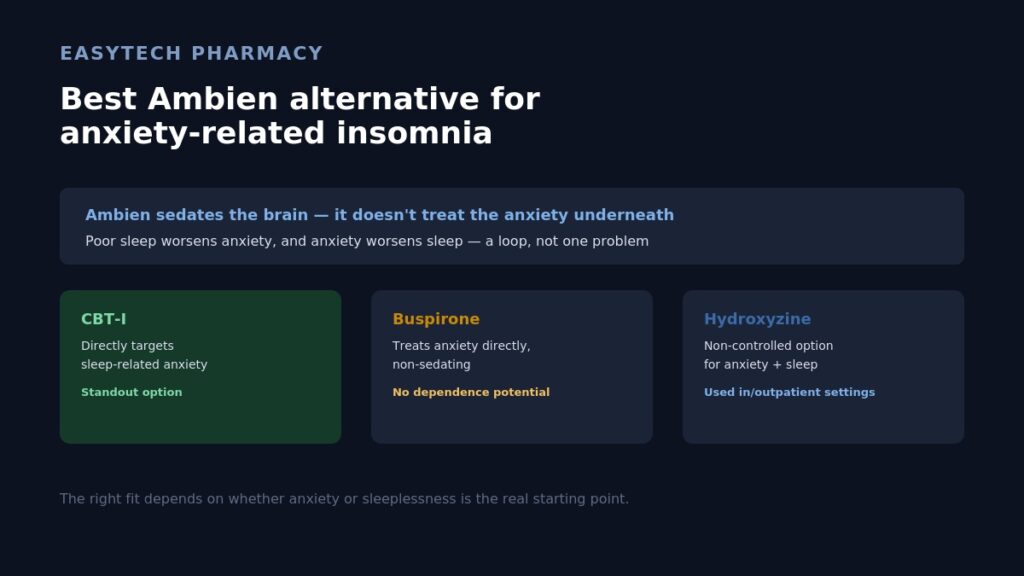
Ambien works by amplifying GABA activity to chemically quiet the brain, regardless of why it’s active in the first place. That’s effective for straightforward sleep-onset problems.Racing thoughts, worry, or a keyed-up nervous system often drive sleep problems. When this happens, sedating the brain without addressing the underlying anxiety acts as a temporary patch rather than a real fix. Insomnia and anxiety feed each other in a continuous loop: poor sleep worsens anxiety, while anxiety destroys sleep. Treating only one side of that loop inevitably falls short.
CBT-I: The Approach Built Specifically for This Loop
This is genuinely the standout option here, and not by a small margin. Cognitive behavioral therapy for insomnia doesn’t just treat sleep symptoms. Its core mechanism targets sleep-related anxiety directly. It also addresses the dysregulated sleep drive and interfering behaviors that perpetuate the cycle. In a systematic review comparing CBT-I against FDA-approved sleep medications, CBT-I held up well against drugs. In fact, clinical trials track its positive effects on psychological outcomes like anxiety as a measured benefit. While our guide on Ambien alternatives covers CBT-I generally, this option specifically targets the root mechanism driving anxiety-fueled insomnia.
Buspirone: An Anxiety Medication That Isn’t a Sedative
Buspirone works differently from both Ambien and benzodiazepines. It targets serotonin receptors rather than GABA directly, treats generalized anxiety without significant sedation, and carries essentially no dependence potential. It’s not a sleep medication in the way Ambien is, but for people whose insomnia is clearly downstream of anxiety, treating the anxiety directly with something non-sedating can resolve the sleep problem as a byproduct rather than masking it nightly.
Hydroxyzine: A Non-Controlled Middle Ground
Hydroxyzine is an antihistamine commonly used as a non-controlled alternative for both anxiety and insomnia together, in both inpatient and outpatient settings. It doesn’t carry the same controlled-substance classification as Ambien, though it shares some anticholinergic concerns with other antihistamines we’ve covered in our guide on Ambien vs. Benadryl, including caution around cognitive effects in older adults.
Low-Dose Doxepin: Sedating Without the Anxiety Blind Spot
Low-dose doxepin is FDA-approved specifically for sleep maintenance and works through antihistamine activity at low doses, offering a sedating option that’s structurally different from Ambien’s direct GABA mechanism. It’s not built specifically for anxiety, but its different mechanism makes it worth knowing about as a genuine alternative path for people who haven’t responded well to Z-drugs.
Where Valerian Root and CBD Actually Fit This Picture
Two options we’ve covered elsewhere become more relevant specifically in the anxiety-insomnia context. Valerian carries some evidence for reducing anxiety alongside its sleep effects, a dual action that fits this scenario better than it fits pure sleep-onset insomnia, covered in our guide on Ambien vs. valerian root. CBD’s evidence base, while thin for sleep specifically, is comparatively stronger for anxiety reduction, meaning better sleep may follow as a secondary effect for some people, a distinction we cover honestly in our guide on Ambien vs. CBD for sleep.
What About Benzodiazepines Like Xanax or Klonopin?
These do address anxiety directly, and sometimes get used for this exact overlap. But they carry their own real risks, including dependence potential that in some ways exceeds Ambien’s, and, notably, benzodiazepines are specifically discouraged in certain populations, including patients with myasthenia gravis, where research has found non-benzodiazepine hypnotics safer for managing co-occurring insomnia. Our comparisons in Ambien vs. Xanax and Ambien vs. Klonopin cover these tradeoffs directly.
How to Actually Think Through This
- Anxiety is clearly the primary problem, sleep trouble is downstream of it? CBT-I or buspirone address the actual driver rather than just the symptom.
- Want something non-sedating that still helps anxiety without a controlled-substance profile? Buspirone fits this specifically.
- Need something sedating but want to avoid Ambien’s exact mechanism? Low-dose doxepin or hydroxyzine offer a genuinely different structural path.
- Prefer to start with something non-prescription first? Valerian root’s dual anxiety-and-sleep evidence makes it a reasonable starting point for milder cases.
The Bottom Line
For insomnia driven primarily by anxiety, the best alternative to Ambien usually isn’t another sleep drug at all, it’s an approach that addresses the anxious activity underneath the sleeplessness. CBT-I stands out specifically because its mechanism directly targets sleep-related anxiety, not just the symptom of lying awake. Buspirone, hydroxyzine, and low-dose doxepin each offer a genuinely different structural path than Ambien for people who need more than behavioral therapy alone. The right fit depends on whether the anxiety or the sleeplessness feels like the real starting point of the cycle.
For a deeper clinical breakdown of anxiety and sleep treatment overlap, see Psychiatric Times’ overview of insomnia treatment in anxiety disorders.
Frequently asked questions
Why doesn’t Ambien work well for anxiety-driven insomnia long-term?
Ambien sedates the brain directly but doesn’t address the underlying anxious activity causing the sleeplessness, so the same pattern often returns once the medication wears off.
Is CBT-I effective specifically for anxiety-related insomnia?
Yes. CBT-I’s core mechanism specifically targets sleep-related anxiety, along with sleep drive and sleep-interfering behaviors, making it particularly well suited to this exact overlap.
Is buspirone a sleep medication?
Not directly. It treats generalized anxiety without significant sedation, but for insomnia driven by anxiety, resolving the anxiety can improve sleep as a secondary effect.
Are benzodiazepines like Xanax a good option for anxiety-related insomnia?
They address anxiety directly but carry their own real dependence risks and are specifically discouraged in certain patient populations, making them a tradeoff worth weighing carefully rather than an automatic choice.
Related reading
- Ambien alternatives: a full overview of your options
- Ambien vs. Xanax: what actually separates them
- Best Non-Habit-Forming Sleep Aids Compared
- Ambien and depression risk: what the research shows
Not sure whether anxiety or sleep is the real starting point of your cycle? Talk to your pharmacist or prescriber. EasyTech Pharmacy can help you think it through.
For local pharmacy access near you, our Ambien near me guide covers pharmacies across the world.
Visit EasyTech Pharmacy — sleep medication with real pharmacist guidance.