The Best Sleep Aid for Trouble Falling Asleep
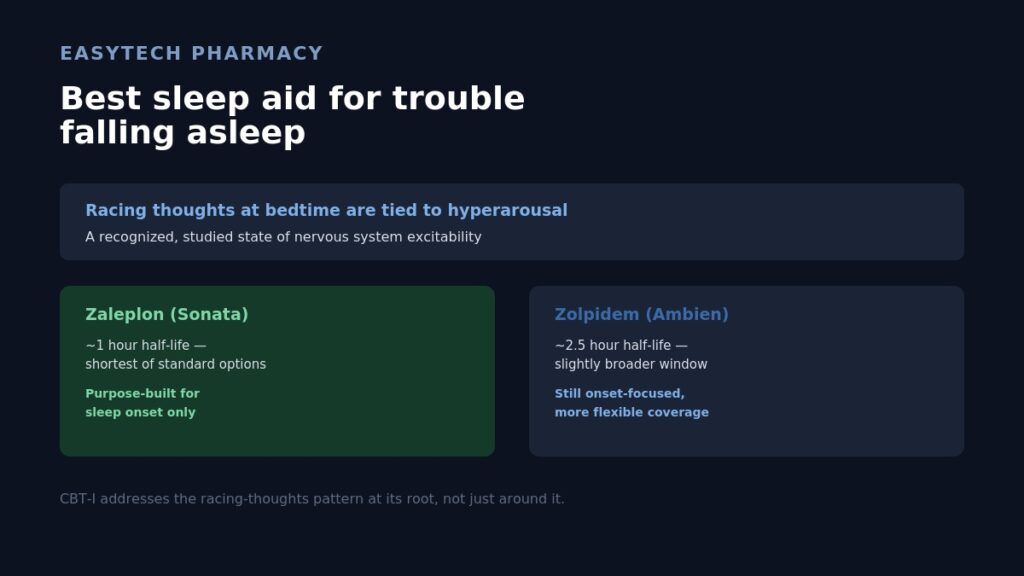
Lying in bed with a mind that won’t power down is a specific, well-understood phenomenon, not just bad luck. It’s called hyperarousal, and understanding that mechanism actually points toward which sleep aids are built to address it, rather than just sedating you broadly and hoping for the best.
What’s Actually Happening When You Can’t Fall Asleep
Insomnia is generally believed to involve hyperarousal in the brain and nervous system, a state of heightened excitability that makes it hard to power down even when you’re genuinely tired. This is distinct from sleep-maintenance insomnia, the frequent-waking pattern we’ve covered separately in our guide on the best sleep aid for frequent nighttime waking. Racing thoughts specifically, the intrusive, hard-to-dismiss mental loop that shows up right at bedtime, has become enough of a recognized clinical phenomenon that researchers are now studying it directly as a distinct feature of insomnia disorder.
Why Onset-Specific Medications Exist as Their Own Category
Sleep-onset insomnia calls for a genuinely different tool than sleep-maintenance insomnia, and the medication landscape reflects that split clearly. Some drugs are engineered specifically to clear the body quickly once their job, getting you to sleep, is done, rather than lingering to support the rest of the night.
Zaleplon: The Most Purpose-Built Option for This Exact Problem
This is genuinely the most precisely targeted medication for sleep-onset difficulty specifically. Zaleplon’s elimination half-life of around one hour is the shortest among standard prescription sleep medications, and it’s used specifically because it decreases the time to sleep onset without meaningfully affecting total sleep time or the number of awakenings later in the night. In plain terms: it does one job, getting you to sleep faster, and gets out of the way after that.
Because of this short duration, zaleplon isn’t effective for people who wake up during the night, a limitation that’s actually a feature for sleep-onset-specific use. It’s meant to be taken immediately before bed, or after experiencing difficulty falling asleep, rather than well in advance.
Ambien: The Broader, More Commonly Used Option
Zolpidem’s roughly 2.5-hour half-life makes it another strong fit for sleep-onset difficulty, with the added flexibility of supporting more of the early sleep period than zaleplon’s ultra-short window. Our guide on eszopiclone vs. zolpidem covers how Ambien’s onset profile compares to Lunesta’s longer-duration design, which leans more toward sleep maintenance instead.
Both Carry the Same Category of Serious Risk
Zaleplon and zolpidem share the same core safety concerns, including complex sleep behaviors like sleep-driving, a risk covered in depth in our guide on Ambien’s black box warning. Rebound insomnia is also documented with zaleplon specifically after stopping, typically lasting about one night, a pattern similar to what we’ve covered in our guide on Ambien rebound insomnia.
Addressing the Hyperarousal Directly, Not Just Sedating Through It
Medication chemically overrides hyperarousal rather than resolving it. For racing thoughts and a keyed-up nervous system specifically, this is exactly where non-medication approaches earn real consideration. CBT-I, covered in depth in our comparison of CBT-I vs. Ambien, directly targets the cognitive arousal patterns driving sleep-onset difficulty, rather than working around them. For sleep trouble specifically tangled up with anxiety, our guide on the best Ambien alternative for anxiety-related insomnia covers options built around that exact mechanism.
Non-Prescription Options Worth Knowing
Melatonin’s circadian-signaling mechanism helps shift the body’s natural sleep window, making it ideal for milder or occasional trouble falling asleep. This approach works especially well when an irregular schedule—rather than pure hyperarousal—triggers racing thoughts. Our guide on Ambien vs. melatonin covers this mechanism in detail.
How to Actually Choose
- Struggle specifically to fall asleep, but sleep fine once you’re out? Zaleplon’s ultra-short, purpose-built design fits this pattern most precisely.
- Want a bit more flexibility and a slightly longer supportive window? Zolpidem offers this while still being well-suited to sleep onset.
- Racing thoughts and mental hyperarousal are the clear driver? CBT-I addresses the underlying pattern directly, rather than just sedating through it nightly.
- Sleep trouble tied to an irregular schedule rather than pure racing thoughts? Melatonin’s timing-based mechanism may fit better than a sedative.
The Bottom Line
Trouble falling asleep stems from a specific, well-understood pattern: nervous system hyperarousal. Fortunately, purpose-built tools address this exact problem. Zaleplon stands out as the most precisely engineered option for sleep onset. It clears the body quickly, avoiding lingering grogginess. Zolpidem offers a broader, onset-focused alternative. Finally, CBT-I addresses racing thoughts at their root rather than chemically overriding them, offering the most durable, long-term relief.
For more on zaleplon’s specific clinical profile, see the StatPearls clinical review of zaleplon.
Frequently asked questions
What’s the fastest-acting sleep medication for falling asleep?
Zaleplon (Sonata) has the shortest half-life among standard prescription sleep medications, around one hour, and is specifically used to reduce time to sleep onset.
Why doesn’t zaleplon help if I wake up during the night?
Its ultra-short half-life means it clears the body quickly after helping you fall asleep, so it doesn’t meaningfully affect total sleep time or reduce awakenings later in the night.
What causes racing thoughts specifically at bedtime?
This is tied to hyperarousal, a heightened state of nervous system excitability that researchers increasingly study as a distinct feature of insomnia disorder, separate from general sleep difficulty.
Is medication the only way to address trouble falling asleep?
No. CBT-I directly targets the cognitive arousal patterns driving sleep-onset difficulty and has strong evidence for durable, long-term improvement without medication.
Related reading
- Best sleep aid for frequent nighttime waking
- CBT-I vs. Ambien: what the research actually shows
- Best Ambien alternative for anxiety-related insomnia
- Short-acting vs. long-acting sleep medications explained
Racing thoughts keeping you up and not sure what’s actually driving it? Talk to your pharmacist. EasyTech Pharmacy can help you think it through.
For local pharmacy access near you, our Ambien near me guide covers pharmacies across the world.
Visit EasyTech Pharmacy — sleep medication with real pharmacist guidance.