Ambien Side Effects — The Complete Guide to What Is Common, What Is Serious, and What to Do
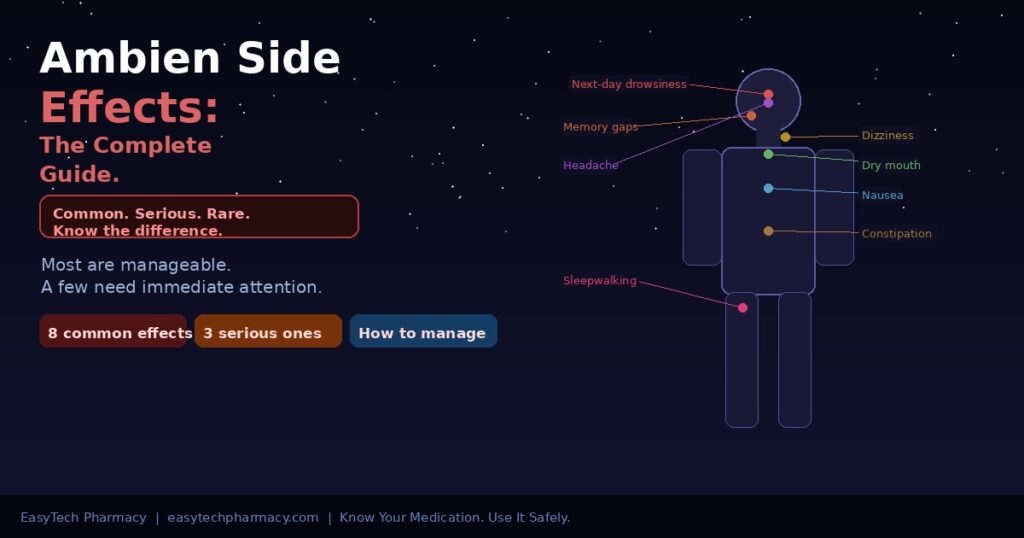
Every medication has a side effect list. Ambien’s is longer than most people expect when they first read it. And it covers a wider range — from mild inconveniences that fade in a few days to genuinely serious effects that require immediate action.
The problem with most side effect lists is that they treat everything with equal weight. Dry mouth and sleepwalking get the same bullet point. That is not useful. Knowing which effects are common and harmless, which are worth monitoring, and which require stopping the medication entirely — that is what actually helps you use Ambien safely.
This is the complete, practical guide to Ambien side effects — organized by seriousness, explained clearly, and paired with what to actually do about each one.
If you are weighing alternatives with a different side effect profile, our comparison of trazodone vs Ambien covers every major option and how they compare.
How Side Effects Are Classified — The Framework That Matters
Before going through each effect, it helps to understand how clinical side effect reporting works. When you see a side effect listed as “common,” that means it occurred in more than 1 in 100 patients in clinical trials. “Uncommon” means 1 in 100 to 1 in 1,000. “Rare” means fewer than 1 in 1,000.
Most of Ambien’s well-known side effects fall in the common to uncommon range. Most of us are dose-dependent — higher doses produce them more frequently and more intensely improve or resolve once the medication is stopped or the dose is reduced.
A small number of Ambien’s effects are rare but serious enough that they warrant immediate attention. Knowing these specifically — and being able to recognize them quickly — is one of the most practically important things any Ambien user can know.
Common Side Effects — What Most People May Experience
Next-Morning Drowsiness and Impairment
This is the most frequently reported Ambien side effect — and the one the FDA has placed its strongest warnings around. Zolpidem has a half-life of approximately 2.5 to 3 hours. However, the medication and its metabolites can remain in the system long enough to produce impairing blood levels the morning after taking it — particularly in women, whose bodies clear zolpidem more slowly than men.
The FDA specifically lowered its recommended doses for women in 2013 after studies showed that next-morning blood levels in many women exceeded the level considered safe for driving. Women metabolize zolpidem approximately 45% more slowly than men on average. The same dose that largely clears from a man’s system by morning may still be at impairing levels in a woman’s system at the same time.
According to the FDA’s official safety communication, patients should not drive or operate machinery the morning after taking Ambien until they feel fully alert — even if they feel subjectively awake and functional. Impairment can persist without obvious subjective awareness.
Managing this effect: the 7 to 8 hour sleep window rule exists specifically to give the medication adequate time to clear. Taking Ambien at 10pm and waking at 5am — only 7 hours — may still produce meaningful next-morning impairment. Giving it the full 8 hours reduces this risk significantly.
Dizziness and Balance Issues
Zolpidem’s CNS depression affects the vestibular system — the brain’s balance and spatial orientation center. Many users experience dizziness or unsteadiness, particularly immediately after waking or when getting up during the night. This is one of the primary fall risks associated with Ambien use.
Older adults are particularly vulnerable because age-related balance changes combine with medication-induced dizziness to create a higher fall risk than in younger users. For adults over 65, Ambien’s fall risk is a significant clinical concern that frequently drives the recommendation to start at the lowest available dose.
Managing this effect: if you need to get up during the night, sit at the edge of the bed for 30 seconds before standing. Keep a clear path to the bathroom. Reduce nighttime obstacles that could become hazards. If dizziness is significant and persistent, discuss a dose reduction with your pharmacist.
Memory Effects and Anterograde Amnesia
Zolpidem affects the hippocampal consolidation process — the way the brain converts short-term experiences into stored memories. For many users, activities that occur in the hour or two after taking Ambien may not be properly consolidated. The result can be a gap in memory — anything from a brief conversation to an extended activity — with no recollection the next morning.
This effect is more pronounced when the medication is taken and sleep is then resisted. The medication has begun affecting memory consolidation, but the person is still awake and engaged. The combination produces the most significant memory gaps. It is one of the core reasons for the “take it immediately before bed” instruction.
Managing this effect: go directly to bed after taking Ambien. Do not make important decisions, have significant conversations, or engage in activities requiring memory formation in the 30 to 60 minutes after taking the medication.
Headache
Headaches are reported by approximately 7% of Ambien users in clinical trials. They most commonly occur on the morning after taking the medication and are thought to be related to mild dehydration from the medication’s mild diuretic effect combined with the reduced fluid intake most people have during sleep hours.
Managing this effect: drink a full glass of water before taking Ambien and another immediately upon waking. This simple habit resolves morning-after headaches for the majority of people who experience them.
Dry Mouth
Ambien reduces saliva production through its anticholinergic effects. Dry mouth is a common early side effect that usually improves within the first week or two as the body adjusts. It can contribute to morning headaches through mild dehydration and can worsen dental health with very long-term use.
Managing this effect: hydration before bed, sugar-free gum or lozenges in the morning, and a bedside glass of water for any overnight dry mouth discomfort.
Nausea
Nausea occurs more commonly when Ambien is taken with or immediately after food. The delayed absorption from a full stomach means peak drug levels hit the system at an unusual time relative to sleep onset, sometimes producing gastrointestinal discomfort. Taking Ambien on an empty stomach or at least 2 hours after eating reduces nausea significantly for most people.
Daytime Fatigue and Cognitive Fog
Some users report lingering fatigue and difficulty with concentration through the following day. This is most common in the first week of use before the body adjusts to the medication. However, persistent daytime fatigue after the initial adjustment period is worth noting — it may indicate the dose is higher than what you personally need, or that the medication is staying in your system longer than average.
Constipation
As covered in detail in our dedicated guide on Can Ambien Cause Constipation?, Ambien’s GABA amplification extends to the gut nervous system, slowing digestive motility. Increased water intake, dietary fiber, and regular movement address this for most people without needing any medication change.
Serious Side Effects — Know These Specifically
These effects are less common but significantly more important. Every person taking Ambien should be able to recognize them.
Parasomnias — Sleepwalking, Sleep-Driving, Sleep-Eating
Parasomnias are complex behaviors performed during sleep — with no conscious awareness and no memory afterward. Sleepwalking is the most commonly known. Sleep-driving — getting into a car and driving while fully asleep — is the most dangerous documented parasomnia associated with Ambien.
These behaviors occur when the brain enters a dissociated state — motor systems active, conscious awareness absent. Ambien’s deep GABA suppression can create this state, particularly at higher doses, when combined with alcohol, or when the medication is taken and sleep is resisted rather than allowed naturally.
This is not a “wait and see” side effect. If anyone in your household reports complex nighttime behaviors — getting up, moving around, leaving rooms, or any other activity you have no memory of — stop taking Ambien and contact your pharmacist immediately. Do not take another dose until you have had that conversation. Remove car keys from easy access. For the full picture on this side effect, our guide on Ambien hallucinations covers the parasomnia mechanism in detail.
Severe Allergic Reactions
Rare but possible — anaphylaxis, angioedema (swelling of the face, lips, tongue, or throat), and serious skin reactions have been reported with zolpidem. These can occur even after previous doses without reaction.
Signs requiring immediate emergency care: difficulty breathing, swelling of the face or throat, hives spreading rapidly across the body, or a sudden drop in blood pressure with lightheadedness. Call 911 immediately if these occur. Do not attempt to drive yourself.
Mood and Behavioral Changes
In rare cases, Ambien has been associated with unusual mood changes — agitation, aggression, hallucinations, worsening depression, and suicidal ideation. The FDA’s black box warning for sedative-hypnotics includes these behavioral effects. They appear more commonly in people with underlying mood disorders and may be more pronounced in older adults.
If anyone close to you notices significant personality or mood changes after starting Ambien — or if you notice them yourself — this requires immediate medical evaluation. Stop taking the medication and seek help the same day.
Side Effects Specific to Women and Older Adults
Two groups face meaningfully different risk profiles with Ambien.
Women
As covered above — women clear zolpidem approximately 45% more slowly than men. This affects virtually every side effect in the list. Next-morning impairment is more pronounced. Memory effects may be stronger. The therapeutic effect may last longer than expected at standard doses. The FDA’s lower recommended starting dose for women (5mg rather than 5–10mg) directly addresses this pharmacokinetic difference. Women should start at 5mg and only increase if needed and tolerated well.
Adults Over 65
Older adults face a compounded risk profile. Hepatic clearance slows with age. Zolpidem stays in the system longer. Cognitive side effects are more pronounced. Fall risk from dizziness and balance impairment is significantly elevated. The standard recommendation for adults over 65 is to start at the lowest available dose — 5mg immediate-release or 6.25mg CR — and only increase under careful monitoring.
Side Effects That Are Often Misattributed to Ambien
Not every symptom that occurs while taking Ambien is caused by Ambien. Some common examples of effects that are frequently blamed on the medication but often have other explanations:
- Morning anxiety: Often a rebound effect from the GABA suppression wearing off — but also frequently a manifestation of underlying anxiety that Ambien was masking rather than treating
- Poor sleep quality despite taking Ambien: More often a sign of tolerance development than a new side effect. Ambien induces sleep but can reduce the proportion of deep restorative sleep stages with extended use
- Depression: Ambien does not typically cause depression — but depression is a major independent cause of insomnia. If depression symptoms emerge during Ambien use it is worth evaluating whether they were pre-existing rather than medication-induced
Our guide on why does Ambien stop working after a few weeks covers tolerance and the broader long-term picture in detail.
How to Minimize Side Effects From the Start
Most of Ambien’s common side effects are dose-dependent and timing-dependent. These practices minimize them from the first dose.
- Start at the lowest effective dose — 5mg IR or 6.25mg CR. You can always adjust upward if needed. Starting high and experiencing significant side effects is harder to undo than starting low and titrating up.
- Take it on an empty stomach — reduces nausea and produces more predictable onset and clearance
- Go directly to bed immediately after taking it — the single most effective step for reducing memory effects and parasomnia risk simultaneously
- No alcohol on the same day — doubles virtually every side effect on this list and converts manageable effects into serious ones. Our guide on Ambien and alcohol covers this interaction fully
- Use for the recommended short-term window — two to four weeks. Extended use significantly increases tolerance, dependence risk, and cumulative exposure to side effects
- Drink water before bed and on waking — addresses headache and dry mouth before they become issues
When to Contact Your Pharmacist or Seek Immediate Help
| Situation | Action | Timeline |
|---|---|---|
| Morning drowsiness affecting driving | Contact pharmacist — discuss dose timing | Before next dose |
| Any evidence of nighttime activity with no memory | Stop medication — contact pharmacist | Same day — do not take another dose |
| Significant mood or personality changes | Stop medication — seek medical evaluation | Same day |
| Facial swelling, difficulty breathing, throat tightening | Call 911 immediately | Immediately — emergency |
| Thoughts of self-harm | Call 988 (Suicide and Crisis Lifeline) or 911 | Immediately |
| Persistent nausea or headache after 2 weeks | Contact pharmacist — dose or timing adjustment | Within the week |
| Medication seems less effective over time | Contact pharmacist — tolerance discussion | Within the week |
Frequently Asked Questions
What are the most common Ambien side effects?
The most commonly reported side effects of Ambien are next-morning drowsiness and impaired alertness, dizziness, headache, dry mouth, and nausea. These occur most frequently at the start of treatment and in dose-dependent patterns — more common at 10mg than at 5mg. Most improve with dose reduction or resolve within the first two weeks of use.
What are the most serious Ambien side effects?
The three most clinically serious side effects are parasomnias (complex behaviors during sleep with no memory — including sleep-driving), severe allergic reactions (anaphylaxis, angioedema), and significant behavioral changes (aggression, hallucinations, worsening depression). These require immediate action — stopping the medication and seeking medical help the same day.
Do Ambien side effects go away?
Common side effects — drowsiness, dizziness, headache, dry mouth, nausea — typically improve within the first one to two weeks as the body adjusts. Next-morning impairment often persists throughout use and is managed through dose timing rather than resolving on its own. All side effects resolve after stopping the medication, though rebound insomnia can temporarily worsen sleep in the days following discontinuation.
Are Ambien side effects worse for women?
Yes — meaningfully. Women clear zolpidem approximately 45% more slowly than men. This extends the duration of virtually every side effect and elevates next-morning impairment risk specifically. The FDA recommends women start at 5mg rather than the higher doses sometimes used for men. This is one of the most important sex-specific medication considerations in sleep pharmacology.
Can Ambien cause depression?
Ambien is not known to directly cause depression. However, worsening of pre-existing depression has been observed in some patients. Additionally, the rebound effect after stopping Ambien can temporarily increase anxiety and mood disruption. If significant depressive symptoms emerge during Ambien use, evaluation by a healthcare provider is appropriate to determine whether the medication, the underlying insomnia, or a pre-existing condition is the primary driver.
What should I do if I experience Ambien side effects?
For mild common effects — adjust dose timing, hydration, and food timing first however persistent common effects — contact your pharmacist about dose adjustment then after serious effects including parasomnias, severe allergic reactions, or significant behavioral changes — stop the medication immediately and seek medical evaluation the same day. For breathing difficulty or throat swelling — call 911 immediately.
Bottom Line — Most Effects Are Manageable, Three Need Immediate Attention
The full picture of Ambien side effects is more manageable than the list looks at first glance. Most common effects — morning drowsiness, dizziness, dry mouth, headache, nausea — are dose-dependent, timing-dependent, and largely preventable through proper use practices. They are not reasons to avoid Ambien. They are reasons to use it correctly.
Three effects are different. Parasomnias, severe allergic reactions, and significant behavioral changes are in a separate category — they require stopping the medication and getting help the same day they occur. Knowing how to recognize them before they happen is the most important preparation any Ambien user can do.
At EasyTech Pharmacy, every order comes with pharmacist support — available to answer questions about side effects, drug interactions, dose adjustments, and whether your current medication is still the right fit for your situation. We carry FDA-approved generic zolpidem in all standard dosages with transparent pricing and fast delivery.
Looking for local options near you? Our Ambien near me guide covers pharmacy access across the US. Interested in alternatives with a different side effect profile? Our guide on sleeping pills that are not habit forming covers every option available.
Visit EasyTech Pharmacy — sleep medication with real pharmacist support behind every order.