Ambien Side Effects in Elderly Patients — What Changes After 65 and What to Do
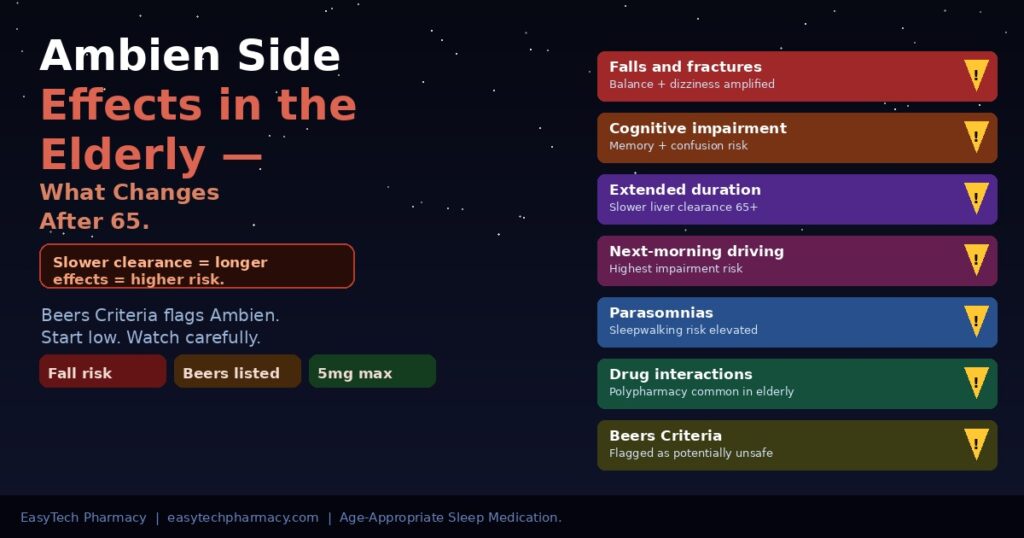
Age changes the relationship with almost every medication. The dose that works well and safely in a 45-year-old produces a meaningfully different effect in a 72-year-old — through the same physiological changes that make aging bodies process drugs more slowly, respond more sensitively, and recover more slowly from adverse effects.
Ambien is one of the medications where this age-related shift is most clinically significant. The American Geriatrics Society — the professional body that sets prescribing standards for elderly patient care — specifically flags zolpidem in their Beers Criteria as potentially inappropriate for adults over 65. That is not a vague caution. It is a specific, evidence-based recommendation that requires understanding to navigate well.
This guide covers Ambien side effects in elderly patients completely — why the risk profile changes with age, which specific effects are most amplified, what the Beers Criteria actually says, and what the safest alternatives look like for older adults who still need sleep support.
For the complete side effect picture applicable to all age groups, our comprehensive guide on Ambien side effects provides the full baseline before this age-specific analysis builds on it.
Why Everything Changes After 65 — The Pharmacokinetic Shift
Two physiological changes account for most of the increased risk profile of Ambien in elderly patients.
Slower Hepatic Clearance
Zolpidem is metabolized primarily in the liver through CYP3A4 and CYP2C9 enzyme systems. Hepatic enzyme activity declines with age — typically by 20% to 40% between young adulthood and age 70. This means zolpidem takes significantly longer to be processed and cleared from an elderly person’s system than from a younger adult’s.
The practical consequence: the same 10mg dose that produces 5 to 6 hours of therapeutic effect in a 40-year-old may produce 8 to 10 hours of active drug presence in a 70-year-old. The medication is still active at blood levels that impair cognitive and motor function when the person needs to be alert and mobile. This extended active window is the direct cause of most of Ambien’s serious adverse effects in elderly patients.
Increased Drug Sensitivity
Age-related changes in GABA receptor density and sensitivity mean that elderly patients respond more strongly to GABA-amplifying medications at the same blood concentration. A blood level of zolpidem that produces mild sedation in a younger adult can produce profound sedation in an elderly patient. Combined with slower clearance, this creates a situation where the medication stays longer AND hits harder.
According to NIH pharmacokinetics research, drug sensitivity in older adults is affected by changes in receptor density, protein binding, body composition (more fat relative to muscle), and reduced renal function — all of which alter how medications behave in the body.
Side Effect 1 — Falls and Fractures (Most Serious)
This is the most clinically consequential Ambien side effect in elderly patients — and the primary reason the Beers Criteria flags it so prominently. Falls in older adults are not minor events. Hip fractures in people over 70 carry mortality rates of 15% to 30% within one year. Falls leading to head trauma produce serious, sometimes fatal consequences. A medication that increases fall risk in this population carries genuine life-threatening implications.
Ambien increases fall risk in elderly patients through multiple mechanisms simultaneously:
- Balance and coordination impairment from CNS depression
- Orthostatic hypotension — sudden BP drop on standing, particularly dangerous when getting up at night
- Prolonged next-morning impairment producing daytime unsteadiness
- Cognitive confusion that impairs hazard recognition
- Nocturnal wakings to use the bathroom — the most common scenario where falls occur
Multiple studies have found significantly elevated fracture rates in elderly patients using zolpidem compared to non-users. A meta-analysis in the British Medical Journal found that sedative-hypnotic use in older adults was associated with a more than 50% increased risk of falls — with zolpidem and other Z-drugs specifically implicated.
Side Effect 2 — Cognitive Impairment and Delirium
Ambien’s effect on memory and cognition — already documented in younger adults — is significantly amplified in elderly patients for several reasons. Age-related cognitive reserve is lower. Sensitivity to GABA-acting medications is higher. Drug clearance is slower — extending the window during which cognitive effects are active.
In elderly patients, zolpidem is associated with:
- Acute delirium — particularly in hospitalized elderly patients where multiple medications and disrupted sleep combine with Ambien’s CNS effects
- Anterograde amnesia more severe than in younger adults — memory gaps extending further and covering more activity
- Next-day cognitive fog interfering with daily activities, driving, and social engagement
- Possible acceleration of cognitive decline with long-term use — an area of ongoing research with concerning preliminary findings
The cognitive risk is the second major reason Beers Criteria places zolpidem in the “potentially inappropriate” category for adults over 65.
Side Effect 3 — Parasomnias at Higher Risk
Sleepwalking, sleep-eating, and other complex behaviors during sleep occur at higher rates in elderly Ambien users than in younger populations — for the same reason most effects are amplified: slower clearance keeps the drug active at dissociative blood levels for longer periods, extending the window during which parasomnias can occur.
In elderly patients, parasomnias carry additional risk because they occur in people with slower reflexes, reduced balance, and more fragile physiology. A sleepwalking episode in a 30-year-old might result in minor disorientation. In a 75-year-old with osteoporosis navigating a darkened home, it can result in a serious fall.
Side Effect 4 — Drug Interactions Through Polypharmacy
Polypharmacy — taking multiple medications simultaneously — is significantly more common in elderly patients than in younger adults. The average person over 65 takes 4 to 5 prescription medications. Many of these interact with zolpidem in clinically meaningful ways.
The most significant interactions in elderly populations include:
- Blood pressure medications — amplifying orthostatic hypotension risk. Our guide on does Ambien lower blood pressure covers this specific combination.
- Other CNS depressants — pain medications, muscle relaxants, antihistamines, anti-anxiety medications, other sedatives — all of which combine with zolpidem to produce additive or synergistic CNS depression
- CYP3A4 inhibitors — certain antibiotics, antifungals, and heart medications slow zolpidem metabolism further in a system that is already processing it slowly
- Alcohol — even small amounts interact more dramatically in elderly patients due to lower tolerance and slower alcohol metabolism
The Beers Criteria — What It Actually Says
The American Geriatrics Society Beers Criteria is the most authoritative clinical guidance for medication use in adults over 65. Updated regularly by a panel of geriatric specialists, it identifies medications that are potentially inappropriate for elderly patients — either because safer alternatives exist or because the risk-benefit ratio is less favorable in older adults than in younger populations.
Zolpidem (and all Z-drugs) appear in the Beers Criteria with the following core concerns:
- Increased risk of cognitive impairment, delirium, falls, fractures, and motor vehicle accidents in older adults
- Hypnotic efficacy is modest — the sleep improvement produced may not justify the risk profile in elderly patients
- Non-pharmacological treatments (CBT-I) and safer medication alternatives should be tried first
Being on the Beers Criteria does not mean a medication is absolutely contraindicated for every elderly patient. It means the prescribing decision requires explicit consideration of whether the benefit in this specific patient outweighs the documented risks — and whether a safer alternative achieves an adequate result first.
What the FDA Says About Dosing for Elderly Patients
The FDA’s guidance for zolpidem in elderly patients is specific and reflects the clinical evidence:
- Starting dose: 5mg for elderly patients — regardless of sex (compared to the 5mg to 10mg range for younger adults)
- Maximum dose: 5mg for most elderly patients — 10mg is not recommended as a starting dose
- Extended-release: 6.25mg starting dose — the lower CR dose is specifically the elderly recommendation
- More frequent monitoring — for signs of cognitive impairment, falls, and excessive daytime sedation
Our dosing guide on Ambien dosage covers these age-specific recommendations in the context of the complete dosing framework.
Safer Alternatives for Elderly Patients Who Need Sleep Support
The Beers Criteria does not simply flag zolpidem without providing direction. The recommended alternatives for elderly patients with insomnia represent the most appropriate non-pharmacological and pharmacological options at this age.
CBT-I First
Cognitive Behavioral Therapy for Insomnia is the recommended first-line treatment for chronic insomnia in all adults — but it is particularly strongly recommended for elderly patients as an alternative to medication precisely because it produces durable improvements without any pharmacological risk. Available through telehealth, apps, and therapists without in-person visits required.
Ramelteon (Rozerem)
The melatonin receptor agonist that is not classified as a controlled substance, carries no dependence risk, and is not flagged by the Beers Criteria for elderly patients. Its mild effect is often adequate for elderly patients with circadian timing issues, and its safety profile is dramatically better than zolpidem in this population.
Low-Dose Doxepin (Silenor 3mg)
FDA-approved specifically for sleep maintenance insomnia. At the 3mg dose, it works through highly selective histamine H1 blockade with significantly fewer anticholinergic effects than standard antidepressant doses. Not flagged by Beers Criteria at these low doses. Particularly appropriate for elderly patients whose primary problem is early morning waking.
Trazodone (Low Dose)
Non-controlled. Lower fall risk profile than zolpidem. Useful for elderly patients where anxiety or mood components accompany the insomnia. Not ideal for patients on multiple blood pressure medications due to orthostatic concerns, but generally better tolerated than Z-drugs in elderly populations. Our comparison of trazodone vs Ambien covers the full picture.
Natural Supplements
Magnesium glycinate (200mg) and low-dose melatonin (0.5 to 1mg) are genuinely well-suited for elderly patients with mild insomnia — no drug interactions at these doses, no fall risk, and no dependence concern. Our guide on natural Ambien alternatives covers every supplement with evidence levels. And for the full range of non-controlled options at every level, our guide on non-benzo sleep aids covers everything systematically.
If Ambien Is Necessary — How to Make It Safer
There are situations where Ambien is used in elderly patients despite the Beers Criteria concerns — when other options have genuinely failed and the insomnia is severely affecting quality of life. In these situations, these steps reduce the risk profile meaningfully:
- Use the lowest possible dose — 5mg IR or 6.25mg CR. Do not escalate without strong clinical justification.
- Use intermittently if possible — 2 to 3 nights per week rather than nightly reduces cumulative exposure
- Remove fall hazards — clear pathways to the bathroom, install night lights, consider a bedside commode if nighttime bathroom trips are frequent
- Sit before standing — 30 seconds at the edge of the bed before standing prevents most orthostatic falls
- No alcohol on any day when medication is taken — the combination in elderly patients is particularly dangerous
- Review all concurrent medications with a pharmacist for interaction risk — particularly other CNS depressants
- Limit to the shortest possible course — two to four weeks maximum before reassessment
Frequently Asked Questions
Is Ambien safe for elderly patients?
Ambien carries significantly higher risk in patients over 65 than in younger adults — due to slower drug clearance, increased drug sensitivity, and age-related physical vulnerabilities like reduced balance and fragile bone density. The American Geriatrics Society Beers Criteria specifically flags zolpidem as potentially inappropriate for elderly patients. Safer alternatives should be tried first when Ambien is used in elderly patients, the lowest possible dose for the shortest possible period is essential.
What is the safest sleep medication for the elderly?
Ramelteon is generally considered the safest prescription sleep option for elderly patients — non-controlled, no dependence risk, not flagged by Beers Criteria, and no significant interaction concerns. Low-dose doxepin (3mg) is also considered appropriate for elderly sleep maintenance insomnia trazodone is commonly used in elderly patients. Non-pharmacological CBT-I remains the most recommended first-line approach regardless of age.
What dose of Ambien is appropriate for elderly patients?
The FDA recommends 5mg immediate-release or 6.25mg controlled-release as the starting dose for elderly patients and these lower doses should generally be maintained rather than escalated 10mg dose is not recommended as a starting point for adults over 65, and should only be considered if the lower dose is genuinely inadequate and the clinical benefit clearly outweighs the additional risk.
Why does Ambien affect elderly patients differently?
Slower hepatic clearance (reduced liver enzyme activity with age) means zolpidem stays active longer. Increased GABA receptor sensitivity means the same blood concentration produces stronger effects. Reduced physical reserves mean the balance, cognitive, and cardiovascular consequences of those effects are more dangerous. The combination of longer duration, stronger effect, and more vulnerable physiology produces the significantly elevated risk profile documented in elderly patients.
Bottom Line — Proceed With Extra Care, Or Not at All
The picture of Ambien side effects in elderly patients is one where ordinary caution becomes essential caution fall that are a nuisance in younger adults become life-threatening in people over 70. Cognitive effects that resolve quickly in younger adults linger in elderly patients with slower clearance. Drug interactions that are manageable in someone taking two medications become complex in someone taking five or six.
The Beers Criteria exists precisely because elderly patients deserve medications evaluated specifically for their physiology — not just medications dosed down from adult guidelines for most elderly patients with insomnia, the progression should start with CBT-I, move to ramelteon or low-dose doxepin if medication is needed, and reach for zolpidem only when those options have genuinely failed and the insomnia is severe enough to justify the additional risk with the safeguards in place.
At EasyTech Pharmacy, our pharmacist team is available to review sleep medication options specifically for elderly patients — helping identify the safest effective choice for each individual situation.
For local pharmacy access near you, our Ambien near me guide covers pharmacies across the US.
Visit EasyTech Pharmacy — age-appropriate sleep medication with real pharmacist guidance.