Is Ambien an Opiate? Clearing Up a Serious Mix-Up
With so much attention on the opioid crisis over the past decade, it’s easy to assume any controlled substance tied to addiction concerns must be an opioid. Ambien gets swept into that assumption fairly often. But it isn’t one, and the distinction isn’t just technical trivia. It actually matters for safety, especially if you’re ever in a position to help someone during an overdose.
This guide explains exactly what separates Ambien from opioids, why the confusion happens, and why getting this right genuinely matters.
The Direct Answer: No, Not Even Close
Ambien, whose active ingredient is zolpidem, is not an opiate or an opioid. It belongs to a completely different drug class, called a Z-drug. Its mechanism, its approved uses, and its risk profile share almost nothing with opioids beyond both being controlled substances.
This isn’t a subtle distinction like the one between Ambien and benzodiazepines, which do share a receptor system. Our guide on is Ambien a benzodiazepine covers that closer relationship. Opioids work through an entirely separate system in the brain, with no meaningful overlap.
What Opioids Actually Are
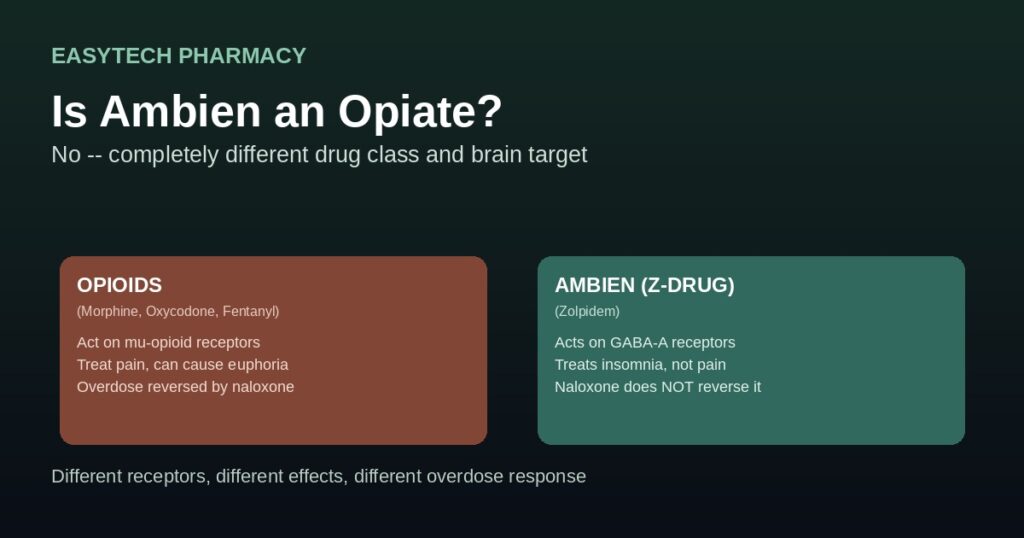
Opioids include drugs like morphine, oxycodone, hydrocodone, and fentanyl, along with illicit substances like heroin. They work by binding to mu-opioid receptors in the brain and body. This produces pain relief, along with the euphoric effect that drives much of their addiction potential.
Opioids are primarily prescribed for pain management. Their most dangerous acute risk is respiratory depression, where breathing slows or stops entirely. This is the core danger behind opioid overdose deaths.
What Ambien Actually Is
Zolpidem works through the GABA-A receptor system, the brain’s main calming pathway. It doesn’t touch opioid receptors at all. Its purpose is entirely different too: short-term treatment of insomnia, not pain relief.
Ambien doesn’t typically produce the euphoric high associated with opioids at therapeutic doses. Its addiction potential, while real, works through a different mechanism, tied more to sedative dependence and, in some cases, its dissociative effects at higher doses. Our guide on zolpidem addiction covers that mechanism directly.
Why the Confusion Happens Anyway
A few real factors explain why people mix these up, even though the drugs themselves are so different.
- Both are controlled substances. Opioids sit in more restrictive schedules, while zolpidem is Schedule IV, but both carry federal controlled substance status, which blurs the distinction in casual conversation
- Both show up in overdose and addiction news coverage. The opioid crisis dominates headlines, and any sedative-related death sometimes gets lumped into that broader narrative inaccurately
- Both are sedating. Drowsiness is a shared surface-level effect, even though the underlying mechanism differs completely
- Both carry real overdose risk when combined with other depressants. This one is legitimate, and it’s covered in detail below
The Genuinely Dangerous Overlap: Combining the Two
Here’s where this distinction becomes a real safety issue, not just a classification question. Combining Ambien with opioids is dangerous, precisely because they’re different drug classes working through different mechanisms that stack on top of each other.
Both drug classes depress the central nervous system, just through separate pathways. Taken together, their sedative and respiratory-depressing effects compound. This combination significantly raises the risk of dangerously slowed breathing, loss of consciousness, and death. The FDA has issued specific warnings about combining CNS depressants like zolpidem with opioids for exactly this reason.
If you’re prescribed both an opioid and Ambien, this combination needs direct, careful oversight rather than casual co-use. Never adjust either dose without guidance.
Why Naloxone Doesn’t Help With an Ambien Overdose
This is one of the most important practical differences, and it’s worth knowing clearly. Naloxone (Narcan) reverses opioid overdoses specifically. It works by blocking opioid receptors, which only helps because opioids are acting on that exact receptor system.
Zolpidem doesn’t touch opioid receptors, so naloxone has no effect on an Ambien overdose on its own. If someone has taken both substances together, naloxone can reverse the opioid component, but it won’t address the zolpidem component of the overdose. This is exactly why combined overdoses are so dangerous. They require full emergency medical response, not just a single reversal medication.
If you ever witness a suspected overdose involving any sedating medication, call 911 immediately. Don’t assume naloxone alone will resolve the situation, especially if multiple substances might be involved.
Other Key Differences Worth Knowing
- Approved uses: Opioids treat pain. Ambien treats insomnia. Neither is approved or effective for the other’s purpose
- Withdrawal profile: Both carry withdrawal risk, but the symptoms and timelines differ. Our guide on how to stop Ambien safely covers zolpidem’s specific process
- Memory effects: Ambien carries a well-documented risk of short-term amnesia, distinct from typical opioid effects. Our guide on does Ambien cause memory loss covers that mechanism
- Legal scheduling: Most prescription opioids sit in Schedule II, reflecting higher abuse potential than zolpidem’s Schedule IV classification
If You’re Concerned About Misuse of Either
Whether the concern involves Ambien, opioids, or both, the response is similar: an honest conversation with a pharmacist or prescriber, rather than managing it alone. Our guide on Ambien abuse covers the warning signs specific to zolpidem misuse, and our overview of Ambien addiction treatment options covers what real help looks like if things have gone further than simple misuse.
According to the National Institute on Drug Abuse, opioids work by binding to specific receptors in the brain and body that block pain signals and can produce a sense of euphoria, a mechanism entirely distinct from how sedative-hypnotics like zolpidem work.
Frequently Asked Questions
Is Ambien an opiate or opioid?
No. Ambien (zolpidem) is a Z-drug, a nonbenzodiazepine sedative-hypnotic. It works through the GABA-A receptor system, completely separate from the mu-opioid receptors that opioids act on.
Can naloxone reverse an Ambien overdose?
No, not on its own. Naloxone specifically blocks opioid receptors, which zolpidem doesn’t interact with. If someone has taken both an opioid and zolpidem, naloxone can address the opioid component, but emergency medical care is still needed for the full picture.
Is it dangerous to take Ambien and an opioid together?
Yes, significantly. Both depress the central nervous system through different pathways, and combining them raises serious risk of dangerously slowed breathing and loss of consciousness. This combination needs direct medical oversight.
Why do people confuse Ambien with opioids?
Both are controlled substances, both cause sedation, and both appear in news coverage about addiction and overdose. But their mechanisms, approved uses, and overdose reversal treatments are completely different.
Is Ambien as addictive as opioids?
Generally, no. Opioids carry higher abuse potential, reflected in their more restrictive drug scheduling. Ambien carries real but comparatively lower addiction risk, through a different mechanism tied to sedative dependence rather than opioid-driven euphoria.
Bottom Line — Different Drugs, Different Risks, Different Responses
Ambien is not an opiate. It works through an entirely separate system in the brain, treats a different condition, and requires a different response in an overdose situation. The one place these two drug classes genuinely intersect is danger: combining them significantly raises overdose risk, and naloxone alone won’t resolve a combined overdose.
If you’re taking both an opioid and Ambien, or supporting someone who is, this distinction is worth understanding clearly, not just for accuracy, but because it could matter in an emergency.
For local pharmacy access, our Ambien near me guide covers options across the world.
👉 Visit EasyTech Pharmacy — find the right sleep medication for your situation today.