Ambien vs. CBD for Sleep: What the Evidence Actually Supports
CBD has picked up a reputation as a gentle, natural sleep fix, largely through word of mouth and marketing rather than the kind of evidence Ambien had to produce for FDA approval. That gap matters. Here’s an honest look at what the actual research on CBD and sleep shows, set against what we already know about Ambien.
One Critical Fact Most Comparisons Skip
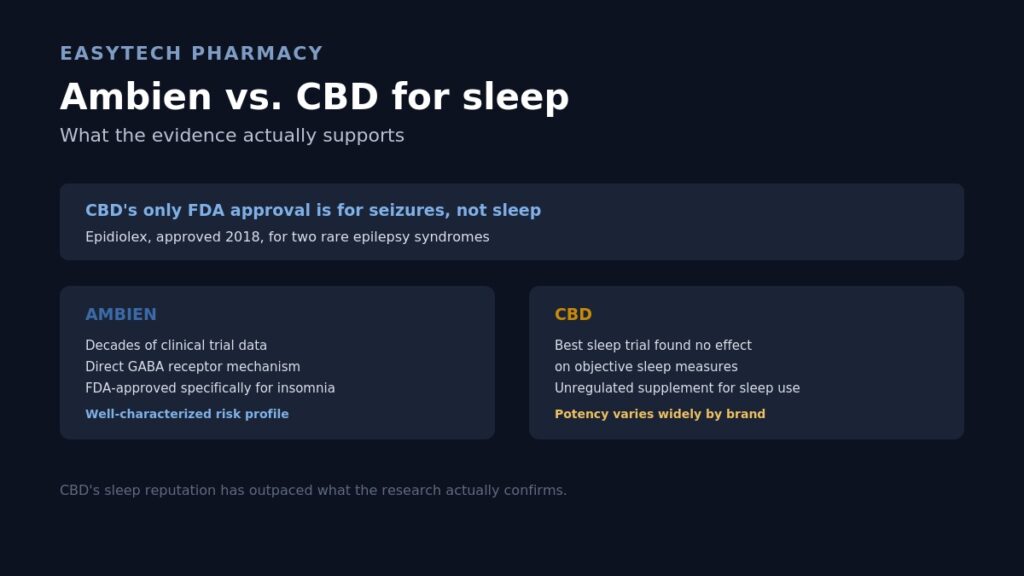
CBD has exactly one FDA approval, and it isn’t for sleep. In 2018, the FDA approved CBD under the brand name Epidiolex to treat seizures from Lennox-Gastaut syndrome and Dravet syndrome. Any CBD product marketed for sleep or wellness sits entirely outside that approval. Instead of regulated medications with proven sleep-specific benefits, these products sell as simple dietary supplements.
What the Actual Sleep Research Shows
This is where the comparison gets genuinely interesting, because the research is more mixed than CBD’s popular reputation suggests. A placebo-controlled trial giving participants 160 mg of CBD found a subjective increase in reported sleep time compared to placebo, but the study didn’t track objective sleep measures at all, meaning it relied entirely on how people described their sleep rather than measuring it directly.
A more rigorous randomized controlled pilot trial using 150 mg of CBD nightly over two weeks found no effect on either subjective or objective sleep measures, though participants did report improved general well-being. Put simply: the best-designed study specifically testing CBD against real sleep metrics didn’t find a sleep benefit, even though people using it felt somewhat better overall.
Why the Evidence Gap Exists
CBD research is genuinely still in an early stage compared to zolpidem’s decades of clinical trial data. Most published CBD research has focused on other conditions, primarily anxiety and inflammation, with sleep-specific investigation lagging well behind. As an exempt nutritional supplement, CBD marketed for sleep isn’t required to prove those specific claims to the FDA before reaching shelves, which is a meaningfully different bar than what Ambien had to clear.
Mechanism: An Indirect Path to Sleep, If Any
Ambien works directly on GABA receptors to chemically induce sedation. CBD interacts with the endocannabinoid system, a regulatory network involved in mood, pain, and inflammation, among other functions, rather than targeting sleep directly. Its potential sleep benefit, where research does suggest one, appears to run through secondary effects like reduced anxiety, not a direct sedating mechanism the way Ambien’s does.
Regulation and Dosing: A Real Gap
Because most CBD sleep products are unregulated supplements rather than approved medications, dosing and potency vary meaningfully between brands, similar to the regulatory gap we’ve covered in our guide on Ambien vs. valerian root. Product labels don’t always accurately reflect actual CBD content, and independent testing has repeatedly found inconsistencies between labeled and actual potency across the supplement market.
Side Effects: Different Profiles Entirely
Ambien’s most notable risks include complex sleep behaviors, covered in our guide on Ambien’s black box warning, and next-day impairment. In clinical studies, CBD’s most commonly reported side effect is somnolence, alongside less frequent reports of appetite changes and digestive issues. Neither list is trivial, but they reflect genuinely different risk categories. Ambien’s risks are well-characterized through extensive trials. By contrast, CBD’s safety picture for sleep-specific use remains thin.
Where CBD Might Genuinely Make Sense Anyway
For people whose sleep trouble is tangled up with anxiety specifically, CBD has somewhat stronger supporting evidence for anxiety reduction than for sleep directly, and better sleep sometimes follows as a secondary effect of feeling calmer. This fits the broader pattern covered in our guide on Ambien alternatives, where addressing an underlying issue sometimes helps sleep more than targeting sleep in isolation.
The Bottom Line
CBD’s reputation as a sleep aid has outpaced its actual evidence base. It holds exactly one FDA approval, for seizures, not sleep, and the clinical research specifically testing CBD against objective sleep measures has produced mixed, often unimpressive results. Ambien, by contrast, has decades of trial data supporting its use for genuine insomnia, alongside real, well-documented risks. Neither makes CBD worthless or Ambien risk-free. It means the comparison isn’t as settled as CBD’s popular reputation suggests.
For a deeper look at current CBD sleep research, see this narrative review of CBD evidence published on PubMed Central.
Frequently asked questions
Is CBD FDA-approved for sleep?
No. CBD’s only FDA approval, under the brand name Epidiolex, is for treating seizures in two rare epilepsy syndromes. CBD marketed for sleep is sold as an unregulated supplement.
Does research actually show CBD helps you sleep?
The evidence is mixed. One trial found a subjective sleep improvement without objective measurement, while a more rigorous trial found no effect on either subjective or objective sleep measures.
Is CBD safer than Ambien?
They carry different, not directly comparable risk profiles. Ambien’s risks are extensively documented through decades of clinical trials, while CBD’s sleep-specific safety data remains comparatively limited.
Can I take CBD and Ambien together?
This combination hasn’t been well studied, and combining any two substances that affect the central nervous system carries potential interaction risk. This is worth discussing directly rather than assuming it’s automatically safe.
Related reading
- Prescription Sleep Aids Compared: Ambien vs. Lunesta vs. Sonata
- Ambien vs. valerian root: what the evidence actually shows
- Best OTC sleep aid vs. Ambien: a full comparison
- Ambien and depression risk: what the research shows
Not sure whether CBD or a prescription option fits your situation better? Talk to your pharmacist. EasyTech Pharmacy can help you think it through.
For local pharmacy access near you, our Ambien near me guide covers pharmacies across the world.
Visit EasyTech Pharmacy — sleep medication with real pharmacist guidance.