OTC Sleep Aids vs. Prescription Sleep Aids: How to Actually Decide
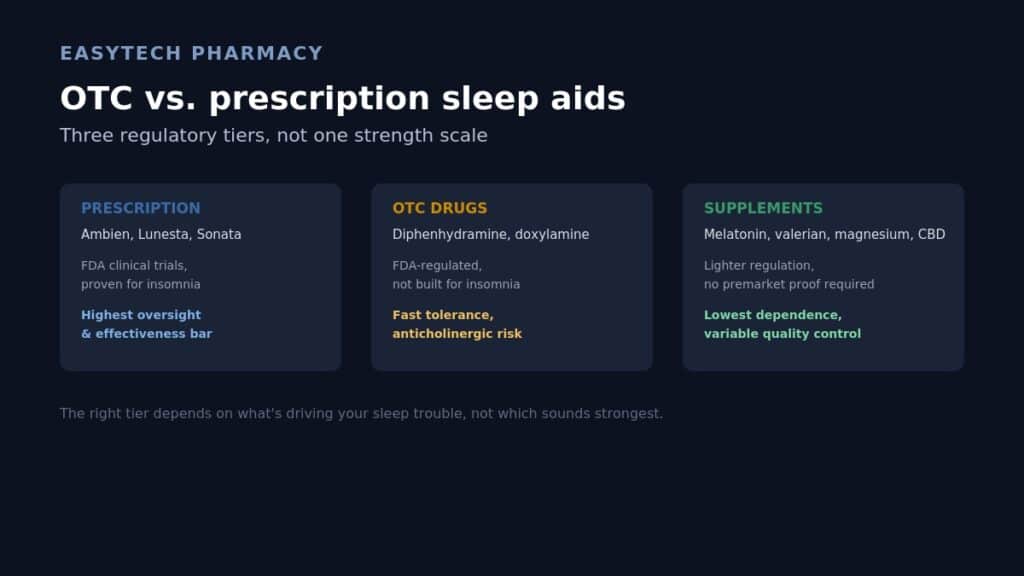
People often frame OTC versus prescription sleep aids as “mild” versus “strong,” but that’s not really what separates them. The actual dividing line is regulatory: what evidence a product had to produce, and how much oversight it needs, before it reaches you. Understanding that distinction, rather than the strength myth, is what actually helps you pick the right starting point.
What Actually Separates the Two Categories
Prescription sleep medications like Ambien went through FDA clinical trials that specifically proved effectiveness for insomnia, standardized manufacturing, and ongoing safety monitoring after approval. OTC sleep aids and supplements face a different, generally lighter regulatory bar. Some, like diphenhydramine, are FDA-regulated OTC drugs with an established safety history, just not one built around treating chronic insomnia specifically. Others, like melatonin and valerian root, are dietary supplements that don’t require the same premarket proof of effectiveness at all.
The Full Landscape, Organized by Tier
Prescription Tier
Ambien (zolpidem), Lunesta (eszopiclone), and Sonata (zaleplon) sit here, each built around a different half-life and each earning FDA approval specifically for insomnia through clinical trial data. Our full breakdown in prescription sleep aids compared covers how these three stack up against each other directly.
OTC Drug Tier
Diphenhydramine (Benadryl) and doxylamine (Unisom) sit here, both FDA-regulated antihistamines with drowsiness as a documented side effect, not their intended purpose. Our full roundup in best OTC sleep aid vs. Ambien covers how these, along with melatonin and valerian, compare.
Supplement Tier
Melatonin, valerian root, magnesium, and CBD sit here, each facing a lighter regulatory standard than either drug tier above. This doesn’t automatically mean lower quality, but it does mean potency and labeling accuracy can vary meaningfully between brands, a pattern covered across our individual guides on valerian root, magnesium, and CBD.
Effectiveness: Not a Simple Hierarchy
It’s tempting to assume prescription automatically beats OTC on pure effectiveness, and for genuine, persistent insomnia, that’s often true. Zolpidem, eszopiclone, and zaleplon each earned approval by demonstrating measurable improvement in clinical trials specifically designed to test insomnia treatment. But this doesn’t hold evenly across every OTC option. Magnesium’s evidence, for instance, is genuinely strong in people who are deficient, and CBT-I, which sits outside both tiers entirely as a non-medication approach, outperforms medication on long-term durability by a wide margin.
Risk: The More Important Axis to Actually Compare On
This is where the categories diverge most meaningfully. Prescription options carry real, well-documented risks: dependence potential, tolerance, and, specifically for Ambien, complex sleep behaviors covered in our guide on Ambien’s black box warning. OTC drugs like diphenhydramine carry their own distinct risk, notably fast-developing tolerance and anticholinergic effects, covered in our guide on Ambien vs. Benadryl. Supplements generally carry the lowest dependence risk of all three tiers but the least consistent quality control.
A Practical Framework for Deciding
- Occasional, mild sleep disruption? Start with an OTC drug or supplement rather than a prescription. Our guide on non-habit-forming sleep aids ranks the lowest-risk options specifically.
- Circadian or timing-specific issue, like jet lag or shift work? Melatonin, specifically, addresses this better than anything in the prescription tier.
- Anxiety is clearly driving the sleeplessness? Our guide on the best Ambien alternative for anxiety-related insomnia covers options built around that specific mechanism.
- You’re a senior, or supporting one? The calculation shifts meaningfully with age. Our guide on the best Ambien alternative for seniors covers what current geriatric guidelines actually recommend.
- Persistent, chronic insomnia that hasn’t responded to anything above? This is where the prescription tier’s trial-backed effectiveness becomes genuinely relevant to discuss.
What Both Tiers Actually Have in Common
Regardless of tier, combining sleep aids compounds sedation risk. Regardless of tier, “more” rarely means “better,” a pattern that shows up in melatonin dosing, magnesium dosing, and prescription dosing alike. And regardless of tier, addressing an underlying cause, whether that’s a nutritional gap, anxiety, or poor sleep habits, tends to outperform simply layering on more sedation.
The Bottom Line
OTC and prescription sleep aids aren’t a simple ladder from weak to strong. They’re different regulatory tiers with different evidence standards, different risk profiles, and different problems they’re actually built to solve. The right starting point depends less on which tier sounds more serious and more on what’s actually driving your sleep trouble, timing, anxiety, a nutritional gap, or genuine chronic insomnia that needs the kind of trial-backed effectiveness only the prescription tier has demonstrated.
For the FDA’s overview of how drug categories are regulated differently, see the FDA’s guide to drug regulation and generics.
Frequently asked questions
Are prescription sleep aids always stronger than OTC options?
For genuine, persistent insomnia, generally yes, since prescription options are backed by clinical trials specifically testing insomnia treatment. But effectiveness varies by the specific problem, and some OTC options, like magnesium for deficiency-related insomnia, have real, though narrower, support.
Is it safer to start with an OTC sleep aid before trying a prescription option?
For occasional or mild sleep trouble, yes, starting with an OTC or non-medication option is generally a reasonable first step before considering a prescription.
Why do supplements face less regulation than OTC drugs?
Supplements like melatonin and valerian root are classified differently than FDA-regulated drugs, facing a lighter premarket standard that doesn’t require the same proof of effectiveness before reaching shelves.
What’s the safest option regardless of category?
Cognitive behavioral therapy for insomnia (CBT-I) sits outside both tiers as a non-medication approach and is considered the safest, most durable first-line option across nearly every population studied.
Related reading
- Best OTC sleep aid vs. Ambien: a full comparison
- Ambien vs. Lunesta vs. Sonata: the full Z-drug comparison
- Best non-habit-forming sleep aids: ranked and compared
- Ambien alternatives: a full overview of your options
Not sure which tier actually fits your situation? Talk to your pharmacist. EasyTech Pharmacy can help you think it through.
For local pharmacy access near you, our Ambien near me guide covers pharmacies across the world.
Visit EasyTech Pharmacy — sleep medication with real pharmacist guidance.