Ambien Dreams and Nightmares — Why They Happen and How to Stop Them
You wake up at 3am, heart pounding. The dream was vivid, strange, and somehow more real than most dreams you have had. It takes a moment to understand where you are. You are home. You are safe. But the dream — or nightmare — lingers in a way that normal dreams rarely do.
If you take Ambien and experience vivid dreams or nightmares, you are not alone and you are not imagining a connection. The relationship between Ambien and dream activity is real, well-documented, and actually quite fascinating once you understand the underlying mechanism. And knowing why it happens makes managing it significantly more straightforward.
This guide covers Ambien dreams and nightmares completely — why they occur, when they are most likely, what the difference is between dreams during use and dreams when stopping, and what actually helps.
The Core Mechanism — What Ambien Does to Your Sleep Architecture
To understand why Ambien causes unusual dream activity, you need to understand what it does to normal sleep stages.
Healthy sleep cycles through four stages approximately every 90 minutes throughout the night. Stages 1 and 2 are light sleep. Stage 3 is deep slow-wave sleep — the most physically restorative stage. REM (Rapid Eye Movement) sleep is the stage associated with vivid dreaming, emotional processing, and memory consolidation.
Ambien, like all GABA-amplifying sedative-hypnotics, significantly suppresses REM sleep. This suppression is consistent and dose-dependent — higher doses produce more REM suppression. During the active window of zolpidem, the brain spends much less time in REM and much more time in deeper slow-wave sleep stages.
This REM suppression is part of why people feel sedated and do not experience normal dream activity while Ambien is working. The medication essentially pushes the brain away from REM and into deeper sleep stages during its active window.
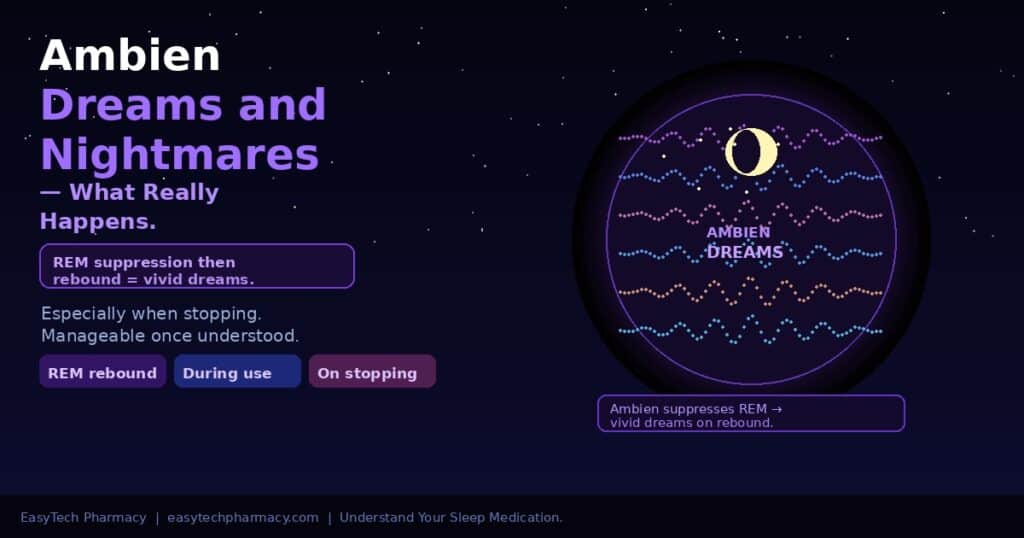
But here is the mechanism that explains the vivid dreams and nightmares — the rebound.
REM Rebound — The Main Cause of Vivid Dreams
The brain maintains a remarkably consistent drive for REM sleep over time. When REM is suppressed — by any GABA-acting medication, by alcohol, or by external sleep disruption — the brain does not simply accept less REM permanently. It compensates. When the suppressing influence is removed, REM activity surges to make up for the deficit.
This is called REM rebound — a temporary increase in REM sleep duration, intensity, and dream vividness that occurs when the suppression is lifted. According to the Sleep Foundation, REM rebound is a well-characterized physiological response to any significant REM suppression — producing more frequent REM periods, longer REM durations, and more vivid, emotionally intense dream content than typical sleep.
For Ambien users, REM rebound occurs in two specific scenarios:
Scenario 1 — During the Night as Ambien Clears
Immediate-release Ambien clears from the system within 5 to 6 hours. In the second half of the night — typically between 3am and 7am — blood levels fall below the threshold that suppresses REM. The brain, which has been denied REM during the drug’s active window, rebounds into intense REM activity during these early morning hours.
This is why Ambien users frequently report their most vivid dreams and nightmares occurring in the early morning — 3am to 6am — rather than at the beginning of the night. The drug is clearing, REM is surging, and the dreams become more intense than normal as a result.
Scenario 2 — When Stopping Ambien After Extended Use
This is when REM rebound is most pronounced. After weeks or months of regular Ambien use — during which the brain has experienced consistent REM suppression — stopping the medication produces a substantial REM rebound that can last several days to two weeks.
During this rebound period, dreams become dramatically more vivid, more frequent, more emotionally intense, and more likely to include nightmares. The rebound can be striking enough to be distressing — and is one of the factors that makes stopping Ambien after extended use uncomfortable even beyond the rebound insomnia. Our guide on why does Ambien stop working after a few weeks covers the full withdrawal and rebound picture.
Dreams During Ambien Use — What People Actually Report
The dream experiences Ambien users report during active use fall into three distinct patterns, each with its own mechanism.
Pattern 1 — Strange, Disjointed, Non-Frightening Dreams
The most common report. Dreams that feel fragmented, illogical, or unusually strange — not frightening, just peculiar. These often occur in the early morning REM rebound window as described above. The unusual quality compared to normal dreams reflects the intensity of the rebound REM rather than any narrative content change.
Pattern 2 — Vivid Nightmares
Some Ambien users experience genuinely frightening nightmares — particularly during the early morning REM rebound window or during dose reduction. The emotional intensity of rebound REM tends to be higher than normal REM, meaning both positive and negative dream emotions are amplified. For people whose baseline dream content involves anxiety themes, this amplification can produce genuinely distressing nightmares.
Pattern 3 — Hypnagogic Experiences Mistaken for Dreams
These are the experiences described in our guide on Ambien hallucinations — perceptual experiences at the sleep-wake boundary that can feel dream-like but occur while some conscious awareness is still present. These are often more vivid and more frightening than the REM rebound dreams described above, but they are technically not dreams — they are hypnagogic hallucinations occurring during the transition into sleep.
Why Some People Experience Nightmares More Than Others
Not everyone taking Ambien experiences vivid dreams or nightmares. Several factors determine individual susceptibility.
Baseline Dream Recall and REM Sensitivity
People who generally recall dreams vividly and frequently are more likely to notice and remember the enhanced REM rebound dreams from Ambien. People with naturally lower dream recall may be experiencing the same REM rebound but not remembering it.
Dose
Higher doses suppress REM more completely — producing a larger rebound debt that clears more intensely. People taking 10mg experience more significant REM suppression and rebound than those at 5mg. Starting at the lowest effective dose reduces this effect.
Duration of Use
The longer Ambien has been used regularly, the larger the cumulative REM debt and the more pronounced the rebound. Short-term use of two to four weeks produces less rebound than months of nightly use.
Anxiety and PTSD
People with anxiety disorders and particularly those with PTSD have baseline dream content that includes more threatening or frightening themes. When REM rebound amplifies the emotional intensity of these dreams, the result can be more distressing nightmares than for people without these underlying conditions. For anxiety-driven insomnia, our guide on trazodone vs Ambien covers why trazodone is often preferable — its serotonin-modulating mechanism may produce better outcomes for anxiety-related nightmare patterns.
Combining With Alcohol
Alcohol independently suppresses REM and produces its own REM rebound in the second half of the night. Combining alcohol with Ambien compounds the REM suppression during the drug’s active window and the rebound during clearing — producing more intense dream activity than either substance alone.
Dreams When Stopping Ambien — What to Expect
The dream landscape when discontinuing Ambien after extended use deserves specific attention because it is one of the most commonly alarming experiences during the stopping process — and one of the least explained.
In the first 1 to 2 weeks after stopping Ambien, expect:
- Significantly more vivid dreams than during use or before starting Ambien
- More frequent dream recall — waking during or immediately after REM periods
- More emotionally intense dream content — both positive and negative themes amplified
- Possible nightmares, particularly in nights 3 through 10 after stopping
- Gradual normalization over 2 to 4 weeks as the brain’s REM balance restores
These experiences are not a sign that something is wrong neurologically. They are the predictable physiological consequence of restored REM after a period of suppression. Understanding this in advance makes the experience much less alarming when it occurs.
What Helps With Ambien-Related Dreams and Nightmares
During Active Use
Take the lowest effective dose: The most direct reduction in REM suppression and subsequent rebound. Moving from 10mg to 5mg often meaningfully reduces dream intensity. Our Ambien side effects covers the dose-dependency of side effects in detail.
Go directly to bed after taking it: Resisting the drowsiness after taking Ambien extends the hypnagogic period during which hallucination-like dream experiences occur. Eliminating this window reduces the unusual perceptual experiences most people describe as “strange dreams.”
No alcohol on the same day: Eliminating alcohol removes the compounding REM suppression and produces more consistent, less dramatically rebounding sleep architecture.
Consider switching formulation: Some people find the extended-release version (Ambien CR) produces less abrupt REM rebound than immediate-release because its slower clearing produces a more gradual reduction in drug levels rather than a sharp drop-off.
For Nightmares Specifically
Image Rehearsal Therapy (IRT): A specific CBT technique for recurrent nightmares that involves consciously rewriting the nightmare’s narrative during waking hours and rehearsing the alternative version. Has strong evidence for reducing nightmare frequency and intensity — particularly useful for people whose Ambien nightmares have a recurring theme.
Reduce dose or switch medication: If nightmares are significantly distressing and dose reduction does not help, switching to trazodone or ramelteon — medications that do not suppress REM — eliminates the rebound mechanism entirely.
When Stopping Ambien
Taper gradually rather than stopping abruptly: A gradual reduction in dose allows the brain to begin REM recovery incrementally rather than all at once, producing less dramatic rebound. Discuss a tapering schedule with your pharmacist.
Know the timeline: REM rebound dreams peak around days 3 to 7 after stopping and typically normalize within 2 to 4 weeks. Having this timeline in mind prevents the common scenario where someone restarts Ambien during the rebound period thinking the dreams are a permanent change.
For natural approaches that support sleep without REM suppression, our guide on natural Ambien alternatives covers every supplement option. None of the plant-based options significantly suppress REM, meaning they do not produce the rebound dream effect.
Frequently Asked Questions
Why does Ambien give me weird dreams?
Ambien suppresses REM sleep during its active window. As blood levels drop in the second half of the night, the brain rebounds into intense REM activity — producing vivid, unusual, or emotionally intense dreams. The “weird” quality reflects the intensity of the rebound REM rather than any change in dream content itself.
Does Ambien cause nightmares?
Yes — in some users, particularly those with anxiety or PTSD, those taking higher doses, and those who have been using it for extended periods. The mechanism is REM rebound amplifying the emotional intensity of dream content. Nightmares are more common during early morning hours when the drug is clearing, and more pronounced during the first 1 to 2 weeks after stopping.
Do Ambien dreams go away?
During active use — they often reduce as the body adjusts over 2 to 4 weeks of regular use, as the brain partly adapts to the REM suppression pattern. When stopping Ambien — dream intensity peaks in the first week and normalizes within 2 to 4 weeks as the brain’s REM balance fully restores.
Are Ambien dreams real hallucinations?
Most are not hallucinations — they are genuine REM rebound dreams occurring in normal sleep. However, some experiences people call “Ambien dreams” are actually hypnagogic hallucinations occurring at the sleep-wake boundary while some conscious awareness remains. The difference is that hypnagogic experiences feel more real and frightening than typical dreams. Our detailed guide on Ambien hallucinations covers this distinction fully.
What sleep medication does not cause vivid dreams?
Medications that do not suppress REM do not produce REM rebound dreams. Trazodone and ramelteon both work through non-REM pathways and do not typically produce vivid dream or nightmare effects. Natural supplements like magnesium and L-theanine have no significant effect on REM architecture. For people whose Ambien dream experience is significantly distressing, switching to a non-REM-suppressing option is the most direct solution.
Bottom Line — The Dreams Are a Sign the Medication Is Working, Not That Something Is Wrong
The mechanism behind Ambien dreams and nightmares is the same mechanism that makes the medication effective — GABA suppression producing sedation also suppresses REM, and when that suppression lifts the brain rebounds. It is not a sign of neurological damage, a sign the medication is harming you, or a random unexplained side effect. It is a predictable physiological consequence of how sedative-hypnotics interact with sleep architecture.
Most of the time it is manageable — lower doses, appropriate timing, no alcohol, and understanding the timeline when stopping. When it is genuinely distressing, switching to a medication that does not suppress REM eliminates the mechanism entirely.
At EasyTech Pharmacy, our pharmacist team is available to help you assess whether your current medication and dose are appropriate — and whether a formulation switch might reduce the dream-related effects you are experiencing.
Looking for local pharmacy access? Our Ambien near me guide covers pharmacies near you across the US.
Visit EasyTech Pharmacy — the right sleep medication with real pharmacist support.