Most Potent Sleeping Pills: Why Stronger Isn’t Safer, and the Risks to Know
Estimated reading time: 6 minutes
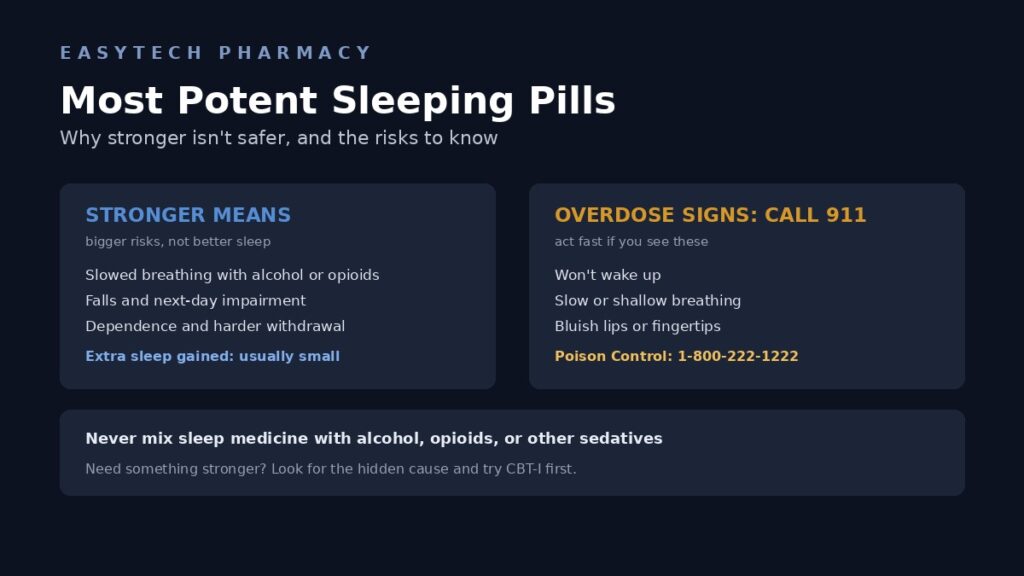
After weeks of poor sleep, it’s natural to wonder about the most potent sleeping pills. If a mild option didn’t work, surely a stronger one will? Unfortunately, it’s not that simple. With sleep medicine, more power usually means more risk, while the extra sleep you gain is often small.
This guide explains what “potent” really means, which groups people usually consider strongest, and the risks that come with them. You’ll also learn the warning signs of an overdose and where to get help fast.
What “Potent” Means for Sleeping Pills
People use “strong” to mean different things. For sleep medicine, it usually covers three ideas:
- Depth of sedation: the degree to which it slows the brain
- Duration: the number of hours it stays active in the body
- Way of acting: broad calming versus a targeted signal
A medicine that sedates deeply and lasts a long time often feels “strongest.” Yet those same traits drive most of the serious risks. In other words, the features that make a pill feel powerful are the ones that make it dangerous.
Which Groups Are Considered the Strongest Sleeping Pills?
Experts usually place these groups at the stronger end:
- Benzodiazepines: older medicines that calm the whole brain broadly, some lasting a very long time
- Z-drugs at higher doses: such as zolpidem, eszopiclone, and zaleplon
- Combinations: two or more sedating medicines taken together
Newer options, like orexin blockers and ramelteon, work in more targeted ways. They usually feel gentler. Curious how two common options compare? Read is Lunesta stronger than Ambien. For every group in one place, see our guide on How Do Sleeping Pills Work.
Why Stronger Sleeping Pills Aren’t Better
Here’s the surprising truth. Research often shows that sleep medicines add a modest amount of extra sleep. Stronger options don’t multiply that benefit. Instead, they mainly multiply the side effects.
Stronger medicines also tend to:
- Leave more grogginess the next day
- Build tolerance faster, so they seem to “stop working”
- Cause harder withdrawal when you stop
- Interact more dangerously with alcohol and other medicines
The Real Risks of the Most Potent Sleeping Pills
Overdose and Slowed Breathing
Strong sedatives can slow breathing, especially when mixed with alcohol, opioids, or other sedating medicines. This is the most dangerous risk of all.
Complex Sleep Behaviors
Some people walk, eat, or even drive while not fully awake, with no memory afterward. These events can happen even on the first night. Our guide on complex sleep behaviors explains the warning signs.
Falls and Injuries
Deep sedation affects balance. Older adults face the highest risk, which is why experts steer them toward gentler options. Our guide to the Safe Sleeping Pills for Elderly Patients explains why.
Dependence and Misuse
Powerful sleeping pills can lead to dependence within weeks. Some people also misuse them for a “high,” which carries serious dangers. Our post on the Ambien high explains why that’s so risky. Learn the early signs in signs of Ambien addiction.
Withdrawal
Stopping a strong sleep aid suddenly can cause rebound insomnia, anxiety, and shakiness. With some benzodiazepines, withdrawal can even cause seizures. Our guide to zolpidem withdrawal symptoms covers what to expect.
Next-Day Impairment
Leftover sedation can slow your reactions the next morning, even when you feel fine. That matters for driving and work. Longer-acting options carry this risk most, especially in older adults.
Never Mix Strong Sleep Medication With These
- Alcohol: stacks the sedation and slows breathing. Read our guide on Ambien and alcohol.
- Opioid pain medicines: the combination can stop breathing
- Other sleep aids: including OTC “PM” pills
- Cannabis and other sedatives: they add to the effect
Overdose Warning Signs: Act Fast
Call 911 right away if someone who took a sleep medicine shows these signs:
- Won’t wake up, or wakes only briefly
- Slow, shallow, or irregular breathing
- Bluish lips or fingertips
- Severe confusion or slurred speech
- Very slow heartbeat
For questions about an accidental extra dose, call Poison Control at 1-800-222-1222. It’s free, confidential, and open 24/7. America’s Poison Centers explains how the service works. Our guide on Ambien overdose signs and effects offers more detail.
Strong Sleeping Pills and Higher-Risk Groups
Some people face extra danger from powerful sedatives. Extra caution matters if you:
- Are over 65, since the body clears medicine more slowly
- Have sleep apnea or another breathing problem
- Have liver or kidney disease
- Are pregnant or breastfeeding
- Take opioids, anxiety medicines, or other sedating drugs
- Have a history of substance use problems
For these groups, gentler options or non-drug care usually make far more sense. A pharmacist can review the full medicine list and flag any risky combinations.
Safer Alternatives to Powerful Sleeping Pills
- CBT-I: the top recommended treatment for chronic insomnia, with no drug risks
- Targeted medicines: options like ramelteon or low-dose doxepin act more precisely
- Treating the cause: fixing apnea, pain, or anxiety often restores sleep
- Daily habits: a steady wake time, morning light, and less caffeine
If You Feel You Need Stronger Sleeping Pills
Wanting something stronger is often a sign that the current plan isn’t working. That’s useful information, not a failure on your part. Instead of raising the dose, try these steps:
- Look for a hidden cause. Sleep apnea, pain, depression, or another medicine may be the real problem.
- Try CBT-I. It often works better than any pill for long-term insomnia.
- Review the timing. Food, caffeine, and late doses can blunt a sleep aid.
- Ask about a different type. A targeted option may suit you better than a stronger one.
Getting Help for Misuse or Dependence
If you or someone you love struggles with sleeping pill misuse, help is available. The SAMHSA National Helpline at 1-800-662-4357 offers free, confidential support 24/7. If anyone has thoughts of self-harm, call or text 988 right away.
FAQs: Most Potent Sleeping Pills
Benzodiazepines and higher doses of Z-drugs usually sit at the strong end. Combining sedating medicines also increases the effect and the danger.
Not really. They mostly increase side effects and risks, while adding little extra sleep.
Ambien is a moderately strong, fast-acting sleep aid. It still carries real risks, including complex sleep behaviors.
No, not without expert advice. Combining sleep aids stacks the sedation and raises the risk of overdose.
Bottom Line — Choose Safer, Not Stronger
The most potent sleeping pills bring the biggest risks: slowed breathing, falls, dependence, and hard withdrawal. Stronger rarely means better sleep. If your current plan isn’t working, look for the real cause, try CBT-I, and ask about safer, more targeted options.
If a sleep aid is part of your plan, our Ambien near me guide shows how to find a local pharmacy and compare prices.
Table of contents
- What “Potent” Means for Sleeping Pills
- Which Groups Are Considered the Strongest Sleeping Pills?
- Why Stronger Sleeping Pills Aren’t Better
- The Real Risks of the Most Potent Sleeping Pills
- Never Mix Strong Sleep Medication With These
- Overdose Warning Signs: Act Fast
- Strong Sleeping Pills and Higher-Risk Groups
- Safer Alternatives to Powerful Sleeping Pills
- If You Feel You Need Stronger Sleeping Pills
- Getting Help for Misuse or Dependence
- FAQs: Most Potent Sleeping Pills
- Bottom Line — Choose Safer, Not Stronger