Is Ambien a Benzodiazepine? Clearing Up a Common Mix-Up
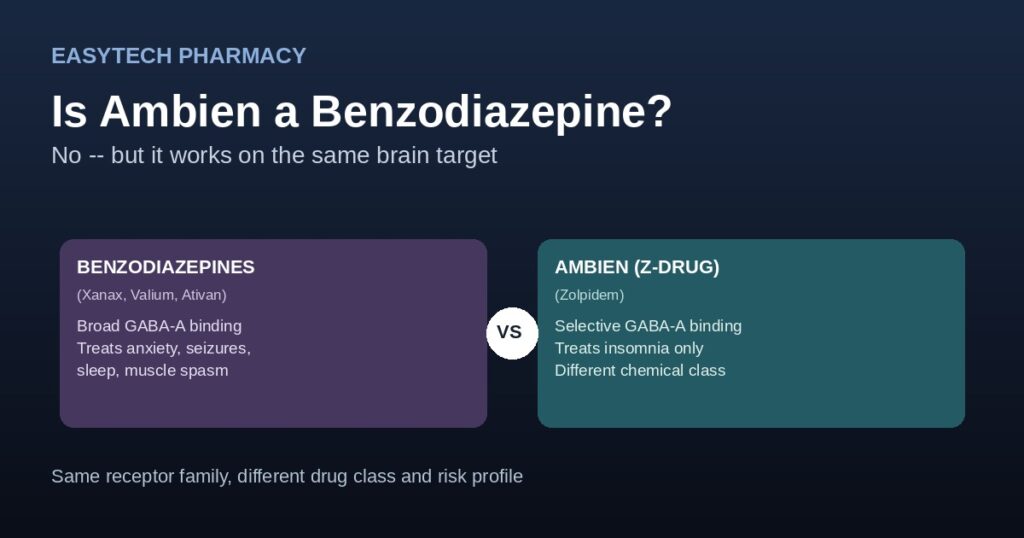
It’s an easy mix-up to make. People group Ambien with Xanax, Valium, and Ativan in casual conversation all the time. Same general category of “calming pill.” Similar warnings on the label. Similar concerns about dependence. But pharmacologically, Ambien isn’t a benzodiazepine at all. It belongs to a distinct class with its own name and its own history. It exists separately for real reasons.
This guide breaks down exactly what Ambien is, if not a benzodiazepine. You’ll learn how the two classes actually differ, and why that distinction matters more than it might seem at first glance.
The Short Answer — No, Ambien Is a “Z-Drug”
Ambien’s active ingredient, zolpidem, belongs to a class of medications informally called “Z-drugs.” The nickname comes from a simple fact: several of the main drugs in this category start with the letter Z. That includes zolpidem (Ambien), zaleplon (Sonata), and eszopiclone (Lunesta).
Researchers developed Z-drugs as an alternative to benzodiazepines for treating insomnia. The goal was to achieve similar sedative effects through a more targeted mechanism. In theory, this would reduce some of the broader side effects and dependence concerns that came with using benzodiazepines for sleep. Whether that goal was fully achieved is a nuanced question, covered further down. But the chemical classification itself is clear. Z-drugs and benzodiazepines are structurally and categorically different medication classes.
Why the Confusion Happens in the First Place
The mix-up isn’t random. There’s a real pharmacological reason people group them together. Understanding it actually clarifies the whole picture, instead of just dismissing the confusion.
Both benzodiazepines and Z-drugs work on the same general receptor system in the brain: GABA-A receptors. Think of these as the primary “brake pedal” of the central nervous system. GABA is the brain’s main inhibitory neurotransmitter. Both drug classes enhance its calming effect. That’s why both produce sedation, both carry similar-looking warning labels, and both show up in the same conversations about sleep and anxiety medication.
The difference lies in exactly how and where they bind to that receptor system. It turns out to matter quite a bit.
The Actual Mechanism Difference
The GABA-A receptor isn’t a single simple switch. It’s a complex protein structure made up of different subunits. Different subunits produce different effects: sedation, muscle relaxation, anti-anxiety effects, and anti-seizure effects, among others.
Benzodiazepines bind broadly across multiple subunit types of the GABA-A receptor. This broad binding is exactly why benzodiazepines have such a wide range of uses. The same basic mechanism produces sedative, anti-anxiety, muscle-relaxant, and anti-seizure effects, because the drug engages several different subunit pathways at once.
Zolpidem binds much more selectively, targeting one specific subunit type called the alpha-1 subunit. This subunit is most strongly associated with sedation specifically. This selective binding is the whole design rationale behind Z-drugs. The goal was to isolate the sedative effect from the other GABA-A-mediated effects. In theory, this produces effective sleep induction with less impact on the broader range of effects benzodiazepines carry.
What This Difference Means in Practice
Approved Uses
Benzodiazepines have a wide range of FDA-approved uses, depending on the specific drug. These include anxiety disorders, seizure conditions, muscle spasms, alcohol withdrawal management, and in some cases, short-term insomnia. Zolpidem has one approved use: short-term treatment of insomnia. That narrower approval reflects its more targeted mechanism.
Duration of Action
Many benzodiazepines, particularly ones like diazepam (Valium), have long half-lives. They produce effects that last well into the next day. That’s part of why doctors use them for conditions requiring sustained calming effect throughout the day. Zolpidem has a short half-life — roughly 2.5 hours. Manufacturers designed it specifically to wear off before morning, minimizing next-day grogginess for a medication meant purely for nighttime sleep. Our guide on how long Ambien makes you sleep covers this timing in more detail.
Controlled Substance Classification
Here’s where the two categories actually converge in a meaningful way. The DEA classifies both benzodiazepines and Z-drugs as Schedule IV controlled substances in the United States. That shared classification reflects a recognized dependence potential in both classes, even though the underlying mechanisms differ. This is one of the strongest reasons people lump the two together in everyday conversation. It’s a legitimate point of similarity, not just a misconception.
Is Ambien Actually Safer Than Benzodiazepines
This is where the real, more complicated answer lives. When Z-drugs first came out, manufacturers often marketed them as a meaningfully safer alternative to benzodiazepines for sleep — less dependence risk, fewer next-day effects, a cleaner mechanism. Many people perceived them that way too.
Decades of real-world use have shown a more mixed picture. Zolpidem does appear to carry somewhat lower dependence risk than benzodiazepines in aggregate. Its shorter half-life also generally means less next-day impairment compared to longer-acting benzodiazepines specifically. Our guide on is Ambien habit forming covers that dependence risk in detail — the honest picture is “somewhat lower than benzodiazepines,” not “risk-free.”
At the same time, zolpidem carries its own set of concerns. They aren’t necessarily less serious than benzodiazepine risks — just different. These include well-documented complex sleep behaviors like sleep-driving and sleep-eating, plus a withdrawal profile that, while generally shorter, follows a similar underlying pattern. Our guide on zolpidem withdrawal symptoms walks through what that process actually looks like.
The fair summary: different class, somewhat different risk profile, but not a clean “safer” versus “riskier” story in either direction. Both classes require careful, informed use.
Why This Classification Matters Practically
Beyond satisfying curiosity, understanding this distinction has a few genuinely practical implications.
- Interaction checking: The mechanisms differ somewhat, so interaction profiles aren’t identical between the two classes. Both still interact significantly with alcohol and other CNS depressants, though. Our guide on Ambien and alcohol covers this specific interaction in depth.
- Switching between medications: If someone moves from a benzodiazepine to Ambien, or the reverse, the different mechanisms mean this isn’t necessarily a like-for-like swap. The transition deserves its own conversation with a pharmacist rather than an assumption of equivalence.
- Reading medical records accurately: Knowing that “Z-drug” and “benzodiazepine” are separate categories helps you make sense of medication lists, insurance formularies, and drug interaction warnings that treat them as distinct entries.
- Understanding your own risk profile: Say you’re specifically trying to avoid benzodiazepines, due to a personal history or a specific concern. Knowing that Ambien is technically in a different class matters. But it’s not automatically the safer alternative — that depends on your specific situation.
- Side effect research: Because Z-drugs and benzodiazepines differ pharmacologically, their side effect profiles aren’t identical either — from complex sleep behaviors down to more surprising questions people search for, like whether Ambien affects hair. Our guide on does Ambien cause hair loss looks at one example most people don’t expect to trace back to sleep medication at all.
Common Benzodiazepines for Comparison
For reference, here are some of the more commonly recognized benzodiazepines, to make the class distinction concrete:
- Alprazolam (Xanax)
- Diazepam (Valium)
- Lorazepam (Ativan)
- Clonazepam (Klonopin)
- Temazepam (Restoril) — notably, one of the few benzodiazepines specifically approved for insomnia
Zolpidem (Ambien) and its Z-drug siblings — zaleplon (Sonata) and eszopiclone (Lunesta) — are chemically distinct from all of these. They share the same general receptor target, but nothing else about their structure.
According to the FDA’s boxed warning update for the benzodiazepine drug class, both benzodiazepines and Z-drugs like zolpidem carry real risks of dependence, misuse, and dangerous interactions with other central nervous system depressants. Classification differences don’t eliminate the need for careful use in either category.
Frequently Asked Questions
Is Ambien a benzodiazepine?
No. Ambien (zolpidem) belongs to a separate drug class called Z-drugs. Z-drugs act on the same GABA-A receptor system as benzodiazepines, but bind more selectively. This produces a more targeted sedative effect with a narrower range of approved uses.
Is Ambien safer than benzodiazepines?
It’s a mixed picture rather than a clear yes. Zolpidem generally has a shorter half-life and somewhat lower documented dependence risk than many benzodiazepines. But it carries its own distinct risks, including complex sleep behaviors, and remains a Schedule IV controlled substance with real dependence potential.
What class of drug is Ambien in?
Ambien is classified as a nonbenzodiazepine sedative-hypnotic, commonly referred to as a Z-drug, alongside zaleplon (Sonata) and eszopiclone (Lunesta).
Why do Ambien and benzodiazepines seem so similar?
Both act on the GABA-A receptor system. Both are Schedule IV controlled substances. Both carry warnings about dependence and interactions with alcohol. That creates a lot of surface-level overlap, even though the chemical classes and specific mechanisms differ.
Can you take Ambien and a benzodiazepine together?
Combining any two GABA-A-acting medications significantly increases sedation and respiratory depression risk. This combination requires careful pharmacist or prescriber guidance — it’s not something to manage on your own.
Bottom Line — Related Mechanism, Distinct Classification
Ambien is not a benzodiazepine. It’s a Z-drug — a related but chemically distinct category built around a more selective GABA-A binding mechanism, designed specifically for treating insomnia. The shared receptor target explains why the confusion is so common. The shared Schedule IV status reflects genuine similarities in dependence risk. But the underlying pharmacology and approved uses set the two classes apart in meaningful, practical ways.
Whether you’re comparing medications, reviewing a prescription list, or just trying to understand what you’re taking, this distinction gives you a more accurate picture. It’s more useful than lumping every “sleep and anxiety pill” into one category.
For local pharmacy access, our Ambien near me guide covers options across the world.